


Knowledge Base
Vibratory Finishing vs Belt and Brush Deburring Machines
Vibratory finishing is a batch process in which parts, abrasive media, water and compound vibrate together in a bowl or tub until burrs wear off. Belt and brush deburring is a through-feed process in which flat parts pass under belts and brushes. Part size, volume, edge result and thickness decide between them.
TFON Machines for This Job
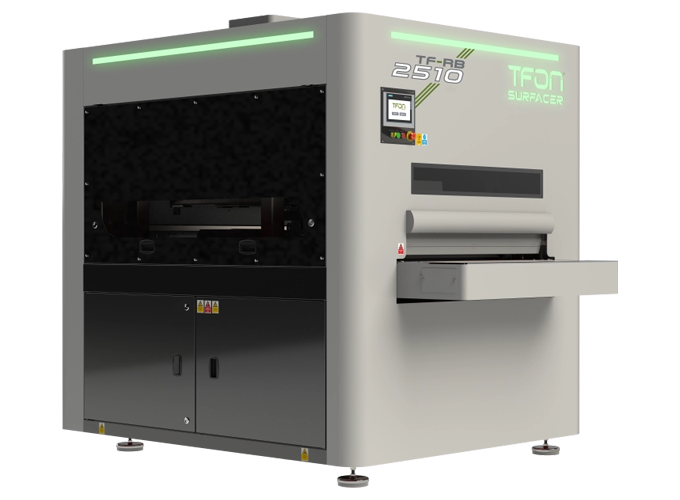
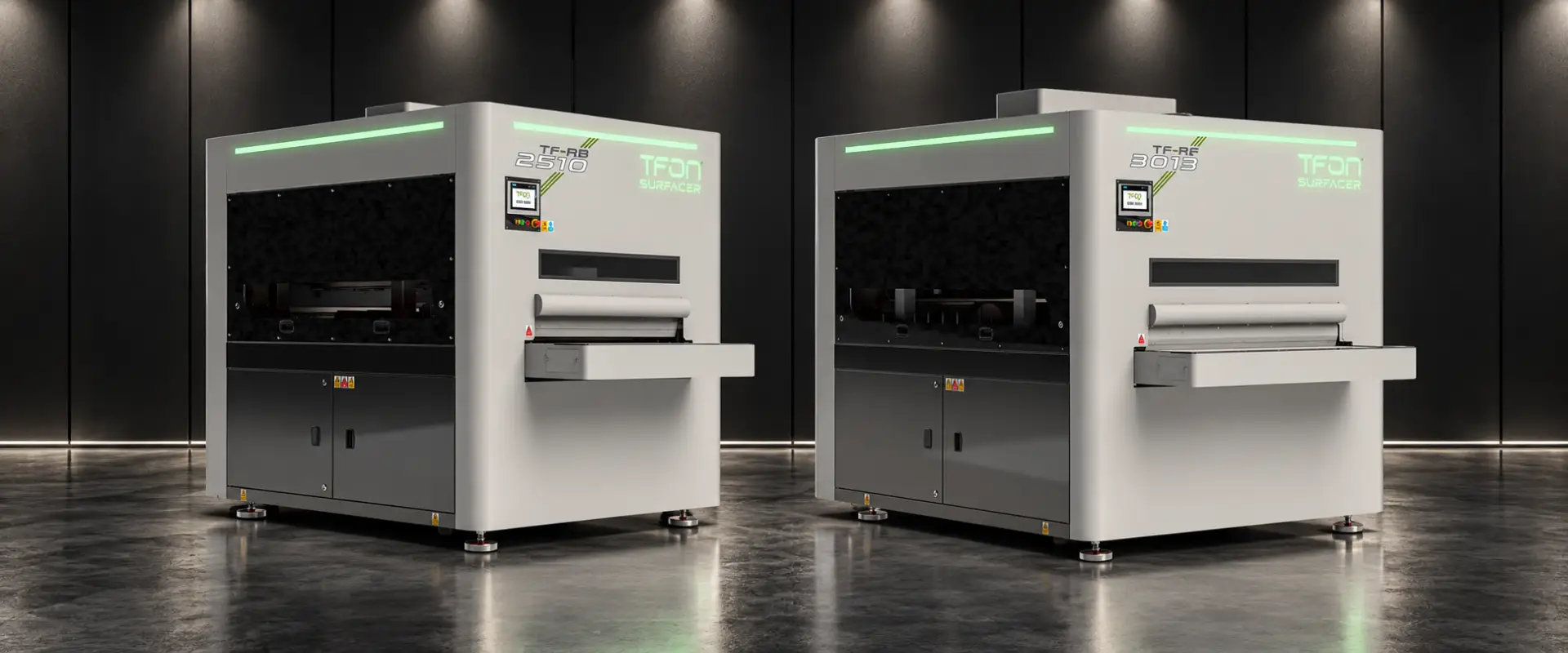
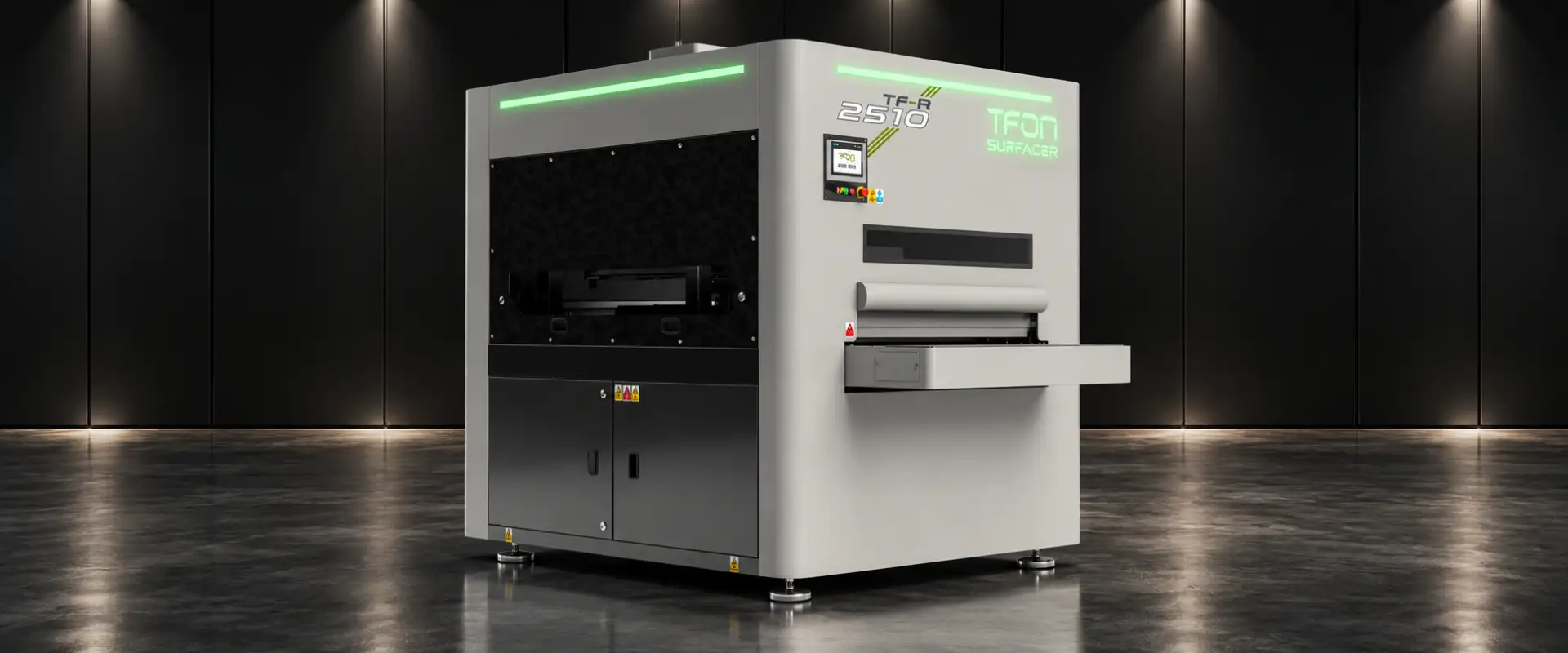
- TFON Surfacer® TF-RB-3013 1,300 mm working width; belt deburring and edge rounding in one pass on flat cut parts Specifications Request a Quote
- TFON Surfacer® TF-R-3013 1,300 mm working width; brush-only edge rounding and oxide removal with minimal effect on the face Specifications Request a Quote
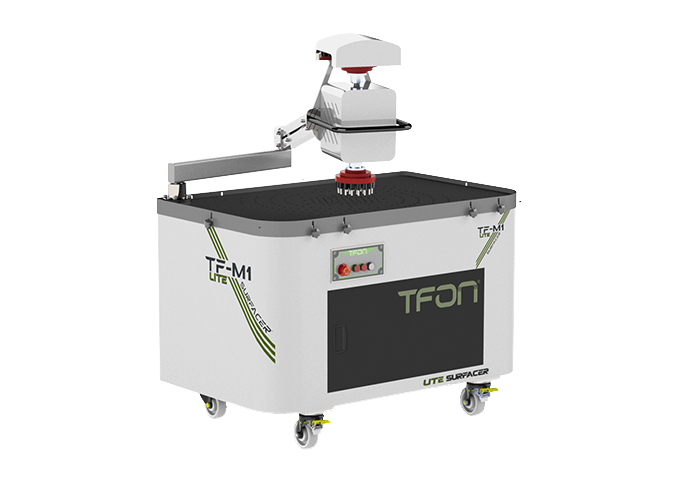
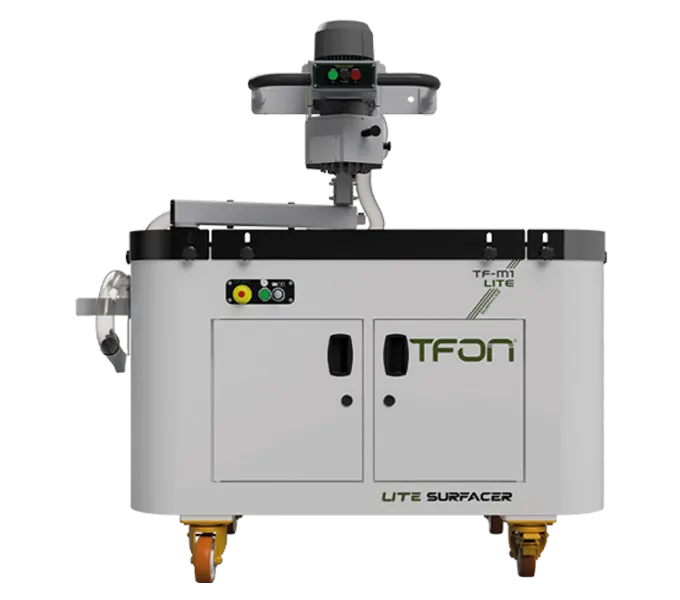
- TFON Lite Surfacer® TF-M1 LITE H1 Manual deburring machine for 3 to 200 mm parts on an 800 x 1300 mm vacuum table Specifications Request a Quote
Vibratory vs Belt and Brush Deburring at a Glance
Vibratory finishing and belt and brush deburring both remove burrs and round edges, but they work on different parts in different ways. Vibratory finishing is a batch process for small, loose parts. Belt and brush deburring is a through-feed process for flat cut parts. Most confusion comes from comparing them on the wrong parts.
| Criterion | Vibratory finishing | Belt and brush deburring machine |
|---|---|---|
| Built by TFON? | No. TFON does not build vibratory or tumble machines | Yes: TFON Surfacer (through-feed) and Lite Surfacer (manual) |
| Process | Batch: parts, media, water and compound in a vibrating bowl or tub | Through-feed: parts on a conveyor pass under belt, brush or disc stations |
| Suitable parts | Small, loose parts that fit the container | Flat cut parts, from small (holding permitting) to wide sheet and plate |
| Faces treated | All faces and edges at once | One face per pass on TFON Surfacer; second face needs a second pass |
| Edge result | Even radius on all exposed edges | Burr cut flush by the belt; radius set by brushes on the processed face |
| Effect on the surface | Whole surface changes appearance | Belt leaves a directional grain; brush-only processing leaves the face largely untouched |
| Heavy slag and plate | Not practical | Heavy slag stations and plate up to high thickness ranges |
| Utilities | Water, compound, wastewater handling, drying | Electrical power, compressed air, dust extraction |
| Repeatability | High within a batch once media and cycle are set | High once settings are stored per part |
One point up front: TFON builds belt, brush and disc machines for flat parts, the Surfacer and Lite Surfacer ranges. It does not build vibratory or tumble finishing machines. This guide compares both processes so you can decide which one your parts need, and it says plainly where vibratory finishing is the better fit.
How Vibratory Finishing Works
A vibratory finishing machine is a bowl or tub on springs, driven by an unbalanced motor. Parts go in with abrasive media, water and a compound. The vibration keeps the whole mass moving, and the media rubs against every exposed surface and edge. Burrs, which stick out, are worn away first, and edges gradually take on a radius.
The result depends on four choices:
- Media: ceramic media cut aggressively and suit steel; plastic media are lighter and gentler, for aluminum and softer alloys; steel media burnish without removing much material; organic media such as corn cob are used for drying and polishing.
- Media size and shape: the media must reach the edges but not lodge in holes and slots.
- Compound: it keeps parts and media clean, carries away fines and can add corrosion protection.
- Cycle time: from minutes to several hours, depending on burr size, media and the finish required.
Round bowls usually have built-in separation of parts and media; tub machines take longer or bulkier parts.
Tumbling vs vibratory finishing
Barrel tumbling does the same job in a rotating drum. The mass slides as the drum turns, so it generally works more slowly than a vibratory machine and is less suited to delicate parts. Both belong to the family of mass finishing processes, along with centrifugal and drag finishing.
The common thread is that the process treats parts as a batch. That is its strength for small parts in quantity and its limit for large or flat sheet metal parts.
How Belt and Brush Deburring Machines Work
A belt and brush deburring machine carries flat parts on a conveyor under a series of stations. Each station treats one edge condition:
- an abrasive belt cuts the burr flush with the face;
- brushes or flap wheels round the edges, reach holes and internal cut-outs, and remove oxide;
- a heavy slag station breaks off dross on thermally cut plate;
- a finishing station gives the face an even satin grain.
Part holding keeps small parts in place against the forces of belts and brushes. Magnetic tables hold ferromagnetic steel; vacuum tables also hold aluminum and non-magnetic stainless steel.
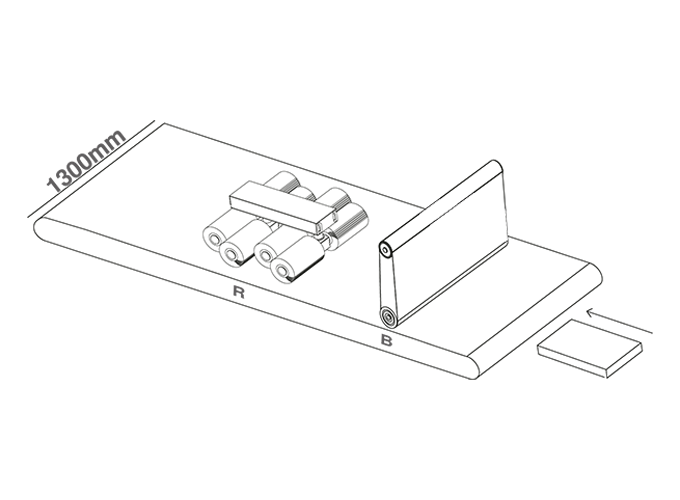
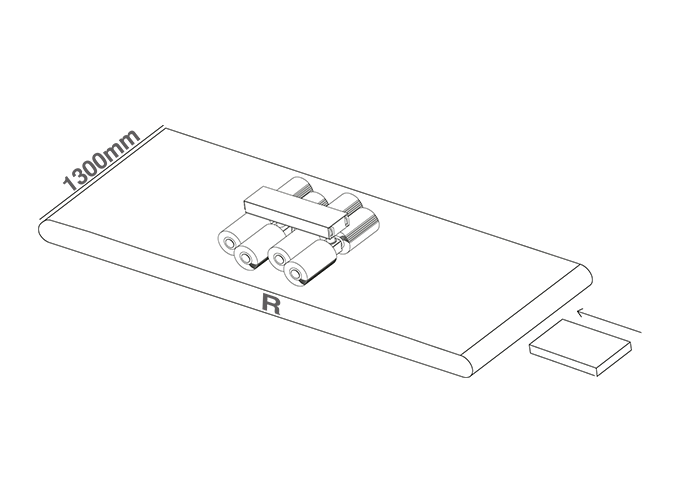
On TFON Surfacer machines, the model code lists the stations: R for edge rounding, B for belt deburring, C for heavy deburring and F for satin finishing. The TF-RB-3013, for example, combines a belt with edge rounding stations for parts up to 1,300 mm wide. Surfacer machines run at a conveyor speed of 0.6 to 4.0 m/min, with vacuum and/or magnetic holding.
Two features set the process apart from vibratory finishing. First, it treats one face per pass: on TFON Surfacer machines, the part is turned over and run again if the second face needs treatment. Second, the settings for each part number can be stored and recalled, so the result is repeatable from part to part rather than from batch to batch.
Belt and brush machines for sheet metal usually run dry and connect to dust extraction. The deburring and edge rounding machines page shows the station combinations TFON builds.
Part Size and Sheet Thickness
Part size is usually the first filter.
Small parts favor vibratory finishing. A tub can hold thousands of small stampings, and each one gets all its edges treated. A through-feed machine needs enough contact area to hold the part: TFON Surfacer machines publish a minimum part size of 50 x 50 mm, depending on holding method and geometry, and the manual Lite Surfacer 80 x 80 mm. Parts below that stay with mass finishing or hand work.
Large and long parts favor belt and brush machines. A conveyor carries parts as long as the line layout allows, and the width is set by the machine: up to 1,000 mm on TFON's 2510 series and 1,300 mm on the 3013 series. Panels of that size do not fit a typical vibratory bowl, and in a large tub they would take up most of the space and risk marking each other.
Thin sheet is a known weak point of wet mass finishing. Thin flat parts tend to stick together in the water film, long thin parts can tangle, and parts can bend or mark each other. Belt and brush machines hold thin sheet flat on the table, although very thin, very small parts need a holding test.
Heavy plate is outside the practical range of vibratory finishing. Belt and brush machines take heavy parts on the conveyor. TFON Surfacer machines publish a thickness capacity of up to 120 mm, subject to application review, and part weights up to 500 kg or 600 kg depending on the series.
A practical rule: if the part is flat and larger than your palm, look at a belt and brush machine first. If it is small, three-dimensional or both, look at vibratory finishing first.
Edge Result and Surface Finish
The two processes leave different edges and different faces, and the next operation decides which result you need.
Edges
Vibratory finishing gives an even radius on all exposed edges, on both faces and around accessible holes, in one cycle. The radius grows with cycle time, and it is hard to treat one edge differently from another.
A belt and brush machine separates the two jobs. The belt removes the burr; the brushes then round the edges to a radius set by grit, number of stations, speed and contact. The result applies to the face being processed, including hole edges on that face. That separation lets you remove the burr on every part while rounding only where the drawing asks for it, and it makes edge rounding measurable and repeatable.
Faces
Vibratory finishing changes the whole surface. Depending on media, parts come out matte, smoothed or burnished. That is useful for small parts that should look uniform, and a problem for parts with a protected face, a coating or a required grain.
A belt leaves a directional grain on the face it touches. On visible stainless parts, a finishing station such as the F station on the TF-RBF-3013 gives that grain a uniform look. Where the face should stay as close to untouched as possible, brush-only processing on a machine like the TF-R-3013 rounds edges and removes oxide with minimal effect on the face.
For painted and powder coated parts, both processes do the job that matters most, removing the sharp edge that would otherwise thin the coating. The surface finishing page covers finish requirements in more detail.
Steel, Stainless Steel and Aluminum
Material changes the details of both processes.
Carbon steel. In vibratory finishing, ceramic media and a compound with corrosion inhibitor are the usual choice, and parts need drying or rust protection before they wait for painting. On a belt and brush machine, carbon steel is the easy case: magnetic holding works, and coarse belts remove heavy burrs and dross quickly.
Stainless steel. Both processes must keep stainless parts free of iron contamination. In a vibratory machine that means media and equipment that have not processed carbon steel. On a belt and brush machine it means a separate set of belts, brushes and discs used only for stainless. Austenitic grades are not magnetic, so they need vacuum holding. Where the face is visible, a belt machine with a finishing station gives a controlled grain, while vibratory finishing gives a uniform matte or burnished look instead.
Aluminum. Aluminum is soft and marks easily. Vibratory finishing uses lighter plastic media to avoid peening and part-on-part damage. Belt and brush machines use vacuum holding and grits chosen to avoid loading the belt. Aluminum grinding dust is combustible and must be collected separately from steel dust.
TFON Surfacer machines are specified for steel, aluminum and stainless steel. For a mixed material shop, the practical questions are the same for both processes: can the parts be held, can the consumables be kept separate, and can the dust or process water be handled safely. The article on deburring stainless steel without damaging the surface covers the stainless case in more detail.
Volume, Cycle Time, Water and Floor Space
Volume and flow. Vibratory finishing works in batches. Parts wait until a batch is full, run for the cycle time, then need separation, rinsing and drying. That suits high volumes of identical small parts. A through-feed machine processes each part as it arrives, which fits a flow from laser or punch to press brake, and mixed part numbers when settings are stored per part.
Water and compound. Vibratory finishing needs water, compound, a way to treat or dispose of the process water, and drying. Carbon steel parts may need rust protection after the wet process, and parts with blind holes need rinsing. Many shops outsource mass finishing precisely to avoid the water handling. Belt and brush machines need electrical power, compressed air (at least 4 bar on TFON Surfacer machines) and dust extraction.
Consumables. Vibratory media wear down and are topped up; compound is used continuously. Belt and brush machines consume abrasive belts, brushes and discs, with life depending on material, burr and duty cycle.
Floor space and handling. A vibratory machine needs space for loading, separation and drying, plus storage for media. A through-feed machine needs space for the machine plus inlet and outlet conveyors. Return conveyors that bring parts back to the operator reduce walking and handling.
Labor. Both processes free operators from hand deburring. With vibratory finishing, the work is loading, unloading and separating batches. With a through-feed machine, it is loading and unloading parts and turning them for a second face if needed. Count that turning when comparing throughput. The guide on deburring machine cost shows how to put these items into a cost per part.
Which Process for Which Parts?
The choice follows the parts. Use this table as a starting point, then confirm it with a trial on your own parts.
| Part situation | Better fit | Reason |
|---|---|---|
| Thousands of small stamped clips or turned parts | Vibratory finishing | Parts are loose and small; all edges treated per batch |
| Laser cut or punched flat parts, 1 to 10 mm, painted later | Belt and brush machine | Burr removed flush and edges rounded in one pass |
| Stainless panels with a visible face | Belt and brush machine with finishing station | Controlled grain on the face; stainless-only consumables |
| Plasma or oxy-fuel plate with dross | Belt and brush machine with heavy slag station | Slag must be broken off; plate too heavy for a tub |
| Parts wider than the tub or longer than the bowl | Belt and brush machine | Conveyor carries long and wide parts |
| Small parts that need every edge rounded on both faces | Vibratory finishing | One cycle reaches both faces |
| Parts smaller than the machine holding limit | Vibratory finishing or hand work | Parts cannot be held against belt and brush forces |
Many shops use both. Small stamped parts go to a vibratory machine or a finishing subcontractor, while flat laser and punched parts run through a belt and brush machine next to the press brake. What does not work well is forcing one process onto the other's parts: large panels into a tub, or tiny clips onto a conveyor.
If your mix is mostly flat sheet parts and you are deciding between hand work and a machine, the guides on deburring tool vs deburring machine and how to deburr sheet metal cover the next steps. For low volumes and rework, the manual Lite Surfacer TF-M1 LITE H1 handles parts from 3 to 200 mm thick on an 800 x 1300 mm vacuum table.
TFON Machines for This Job
-
TFON Surfacer® TF-RB-3013
1,300 mm working width; belt deburring and edge rounding in one pass on flat cut parts
Specifications Request a Quote -
TFON Surfacer® TF-R-3013
1,300 mm working width; brush-only edge rounding and oxide removal with minimal effect on the face
Specifications Request a Quote -
TFON Lite Surfacer® TF-M1 LITE H1
Manual deburring machine for 3 to 200 mm parts on an 800 x 1300 mm vacuum table
Specifications Request a Quote
Frequently Asked Questions
What is the difference between tumbling and vibratory finishing?
Both are mass finishing processes that use media to deburr batches of parts. Tumbling rotates the parts and media in a barrel, so the mass slides as the drum turns. Vibratory finishing shakes a bowl or tub, which keeps the whole load in motion and generally works faster and more gently on delicate parts.
Does TFON make vibratory deburring machines?
No. TFON builds belt, brush and disc deburring machines for flat cut parts: the Surfacer through-feed range and the manual Lite Surfacer. For small loose parts that need vibratory finishing, a mass finishing supplier or a finishing subcontractor is the right contact.
Can vibratory finishing deburr laser cut sheet metal parts?
Small ones, yes. Small laser cut parts can be deburred in a vibratory machine, as long as they do not stick together, bend or trap media in holes. Larger flat parts and panels are better suited to a belt and brush machine, which holds them flat and treats one face per pass.
Can a brush deburring machine round edges on both faces?
Yes, but on TFON Surfacer machines not in the same pass. The machine processes one face per pass as standard. To round the edges on the second face, the part is turned over and run through again. Include that second pass in throughput and cost calculations.
Is chamfering the same as deburring?
No. Deburring removes unwanted material from an edge. Chamfering cuts a defined angled face onto the edge, and edge rounding gives it a defined radius. A part can need all three, and each one should be specified and checked separately on the drawing.
Let Us Review Your Part
Share the material, cutting method, part dimensions and the next operation, with photos of both faces. We will recommend the machine and station sequence that fits the part.