


Knowledge Base
Deburring Tool or Deburring Machine: Which Do You Need?
A deburring tool is a hand tool, such as a swivel blade, countersink, scraper or grinder, used to remove burrs from edges one part at a time. A deburring machine does the same job with its own drive, holding and abrasives. Volume, part size, required repeatability and operator exposure decide which one fits.
TFON Machines for This Job
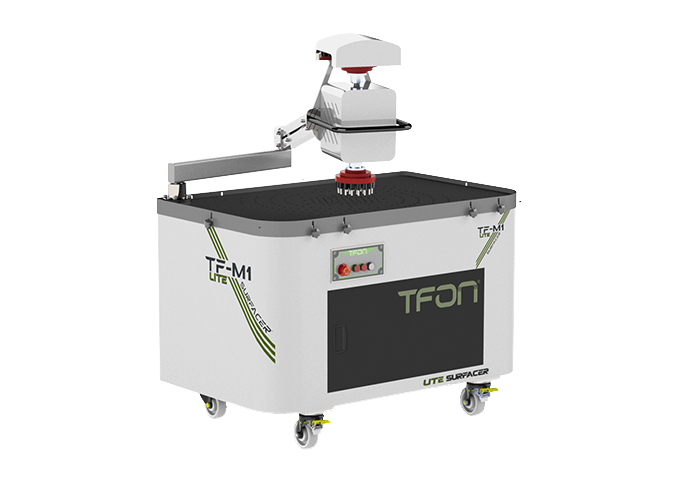
- TFON Lite Surfacer® TF-M1 LITE H1 Manual single-head deburring machine: 3 to 200 mm thickness, 800 x 1300 mm vacuum table, 5.5 kW Specifications Request a Quote
- TFON Lite Surfacer® TF-M1 LITE H2 Manual two-head deburring machine: 3 to 200 mm thickness, parts up to 800 x 1500 mm, vacuum holding Specifications Request a Quote
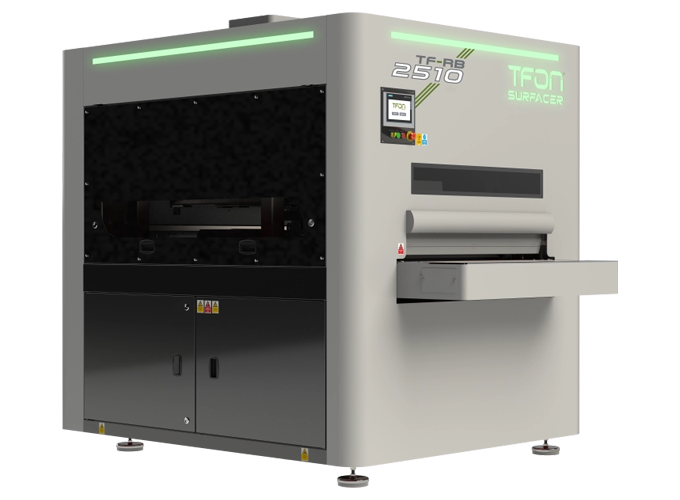
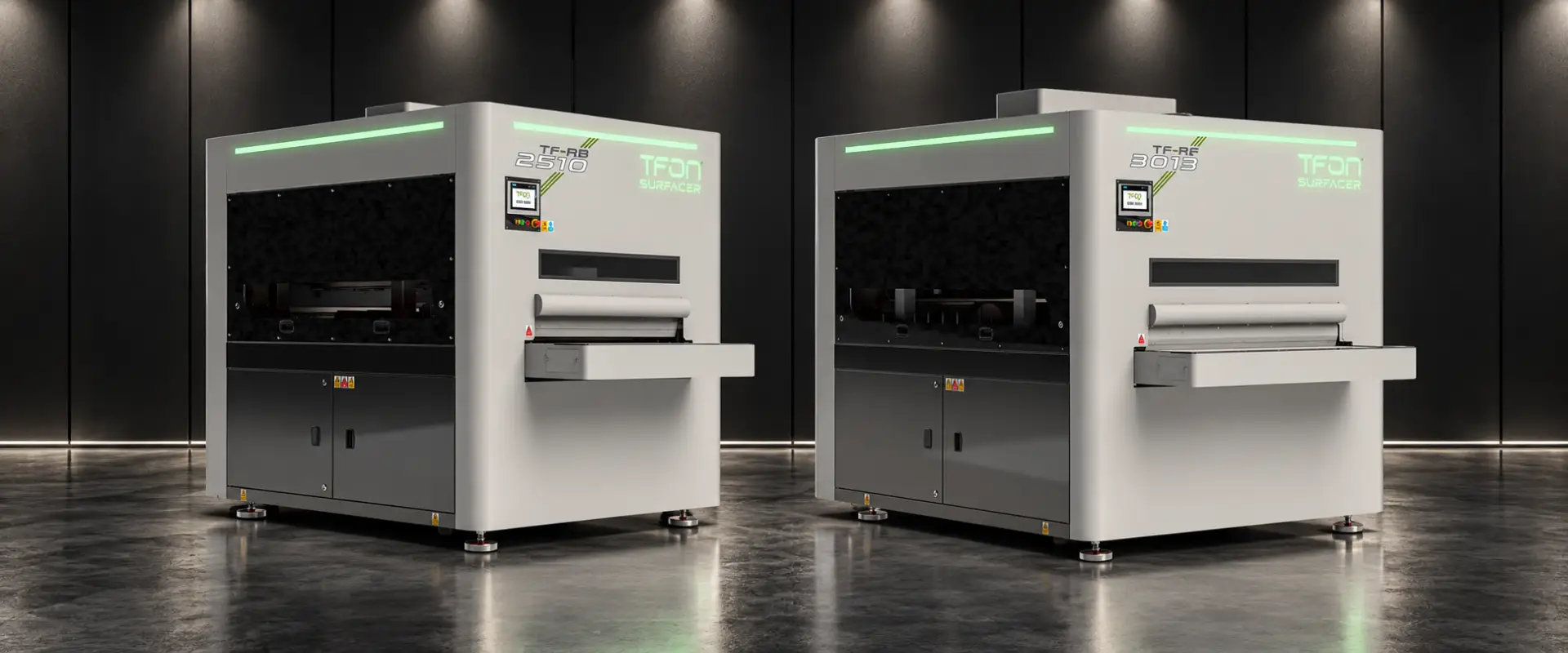
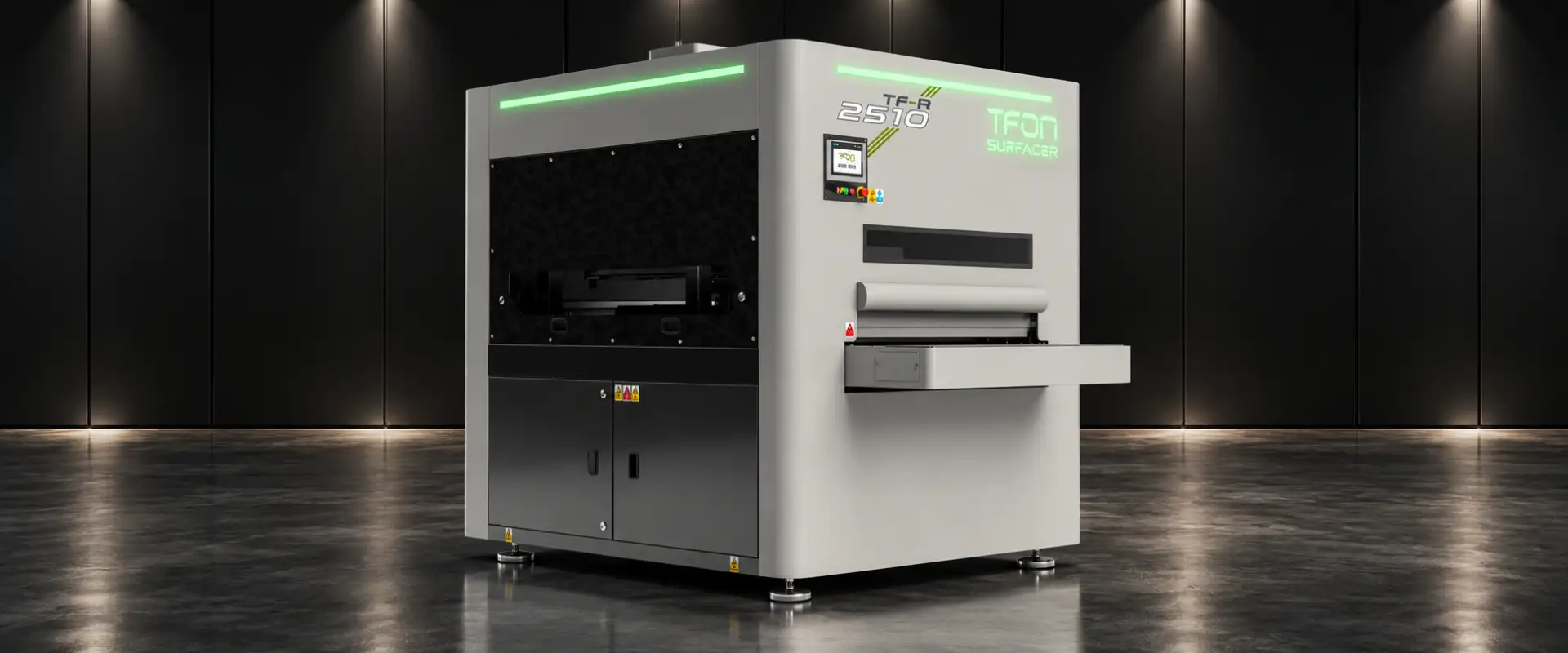
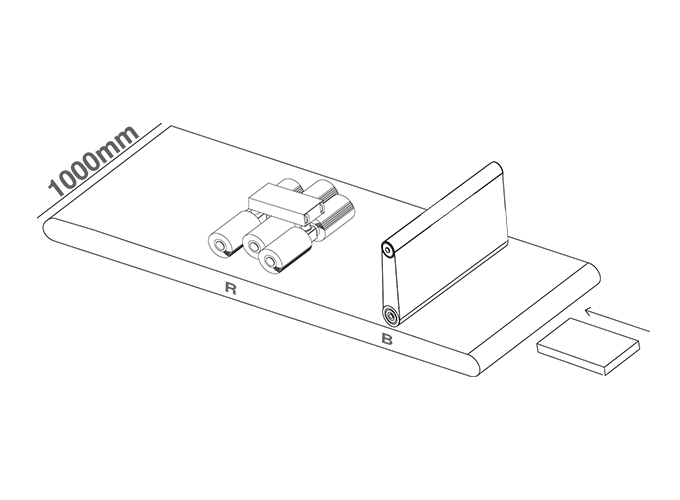
- TFON Surfacer® TF-RB-2510 1,000 mm through-feed machine; belt deburring and edge rounding in one pass for repeat parts Specifications Request a Quote
What Is a Deburring Tool?
A deburring tool is a hand tool that removes burrs, the small projections of material left on edges after cutting, drilling, punching or machining. Most people picture a pen-shaped handle with a replaceable swivel blade, but the term also covers countersinks, scrapers, files, edge chamfering tools and the power tools fabricators use on heavier work.
| Tool | How it works | Suits | Limits |
|---|---|---|---|
| Swivel blade deburrer | Hooked blade in a rotating holder, pulled along the edge | Sheet edges, hole rims, pipe and tube ends | Light burrs; result depends on hand angle |
| Double-blade edge tool | Two blades take a small chamfer off both corners of a sheet edge | Straight edges of thin sheet | Thin material only; straight runs |
| Countersink or rotary deburrer | Conical cutter turned in a hole, by hand or in a drill | Hole edges on either face | Can cut an unwanted chamfer |
| Scraper and file | Manual cutting of the burr | Short edges, heavier burrs, tight spots | Slow; tiring on long edges |
| Sandpaper and non-woven pads | Abrasive rubbing along the edge | Light burrs and edge breaks on thin sheet | Slow, uneven radius |
| Angle grinder with flap or non-woven disc | Powered abrasive on the edge | Heavy plate, dross, weld prep | Gouges, vibration, noise, dust |
| Die grinder with carbide burr | Rotary cutter shapes or cuts the burr | Contours, slots, internal corners | Operator skill; chips and noise |
All of these tools share three traits. They are cheap to buy, they reach almost any edge, and the result depends on the person using them: the angle of the blade, the pressure, the number of strokes and the attention paid to the fiftieth part of the day. That is not a weakness for a prototype or a repair. It becomes one when the same part runs every week and the customer expects the same edge on every piece.
Hand tools also leave the underside to memory. On punched and laser cut parts the burr sits on the exit side, and a part that looks clean from above can still cut the next person who picks it up. The guide What Is a Burr? shows where burrs form on each type of cut.
What Is a Deburrer?
"Deburrer" has three meanings in shop language, and searches mix all three.
- A hand tool. Most often, a deburrer is the swivel blade or countersink-type tool described above. Plumbers and pipe fitters use inside and outside pipe deburrers to clean tube ends after cutting.
- A machine. A deburring machine is sometimes shortened to deburrer, especially for bench machines and through-feed machines that deburr flat parts.
- A person. In job postings, a deburrer or deburr operator is the worker who removes burrs from parts, by hand or by running a deburring machine.
The overlap is not accidental. In many sheet metal shops, the deburrer as a job exists because parts leave the laser or punch press with burrs and someone has to take them off before bending, welding or painting. When that job becomes a full shift, or when two or three people do it on different shifts with different results, the question this guide answers comes up: keep adding hands and hand tools, or move the work to a machine?
For the process itself, the sheet metal deburring page explains how to separate burr removal from edge rounding and what to inspect afterward.
What Is a Good Sheet Metal Deburring Tool?
A good sheet metal deburring tool is the one that matches the edge, the thickness and the number of parts. Judge candidates on these points:
- Edge type. Straight outside edges suit a double-blade edge tool or a swivel blade. Holes need a countersink or a back-deburring tool. Internal corners and slots need a scraper, a file or a die grinder.
- Thickness and burr size. Thin sheet with a light burr needs a light touch; heavy plate with dross needs a grinder or an impact tool.
- Material. Stainless steel and aluminum need tools and abrasives kept separate from carbon steel work, so that iron particles and cross-contamination do not cause rust spots or coating defects.
- Control. The tool should remove the burr without cutting a chamfer that changes the part. Blades with a stop or a defined angle help on thin sheet.
- Ergonomics. Handle shape, weight and vibration decide how the tool performs at the end of a shift, not only in the first minute.
- Consumable cost. Blades, discs and pads add up across a year of production.
No single hand tool covers all six. That is why most workbenches carry four or five of them, and why a mixed production usually needs a mix of methods. The guide on how to deburr sheet metal compares hand tools with vibratory, belt and brush methods by part size and volume.
When Does a Deburring Machine Make Sense?
There is no fixed part count at which a machine becomes the right choice, because part size, edge length, burr size and labor cost differ between shops. The decision is easier to make from signals you can observe on your own floor.
| Signal in your shop | Hand tools | Manual deburring machine | Through-feed deburring machine |
|---|---|---|---|
| Volume | Single parts, prototypes | Low volumes, mixed jobs, rework | Repeat batches, same part numbers every week |
| Part size and weight | Small parts or one-off heavy pieces | Parts that fit the table and can be guided by hand | Flat parts within working width and weight rating |
| Edge requirement | Burr removed, no stated radius | Burr removed, edge broken or rounded | Defined radius, oxide-free, same result every part |
| Repeatability | Varies by operator and time of day | Depends on the operator | Set by stored settings |
| Operator exposure | Cuts, vibration, dust, repetitive work | Reduced; operator guides the part | Mostly loading and unloading |
| Deburring vs cutting time | Deburring is a small share | Deburring slows mixed jobs | Deburring is the bottleneck after cutting |
A practical test is to time it. Measure the hand deburring minutes for your ten highest-volume part numbers, including turning the part and checking both faces, and multiply by the yearly quantity. Compare that labor, plus rework and rejects caused by missed burrs, with the cost per part of a machine. The guide on deburring machine cost shows which factors enter that calculation.
Count the hidden costs as well. Hand deburring creates piles of cut parts waiting between the laser and the press brake, adds an extra handling step for every piece, and turns up in customer complaints when a burr on the underside slips through. It also ties the output of the whole cell to the number of people available on a given shift. None of these costs shows up in the price of a deburring tool, but each one shows up in the cost of a finished part.
Two situations usually decide it quickly. The first is a written edge requirement, such as a radius for powder coating, that hand work cannot hold consistently. The second is deburring becoming the bottleneck between a fast laser or punch and the press brake, so that cut parts wait in piles.
The Middle Step: A Manual Deburring Machine
Between a drawer of hand tools and a through-feed line sits the manual deburring machine. The operator still guides the part, but the machine provides the holding, the drive and the abrasive, so the work is faster, less tiring and more consistent than with a hand grinder.
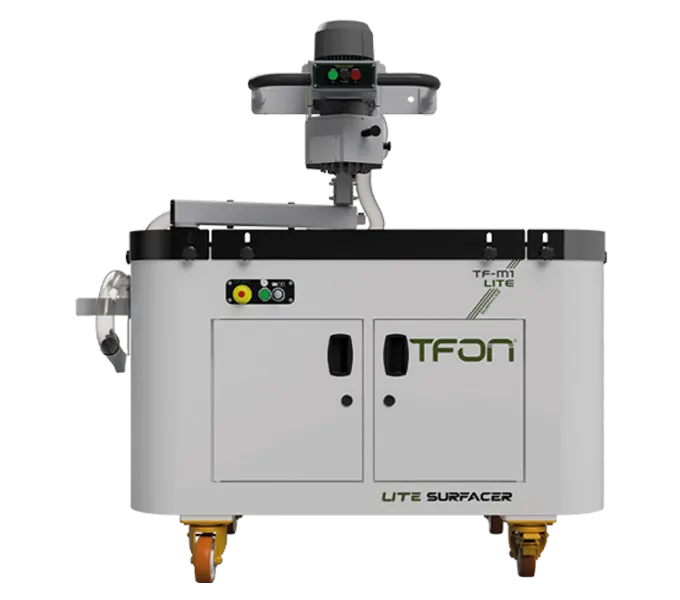
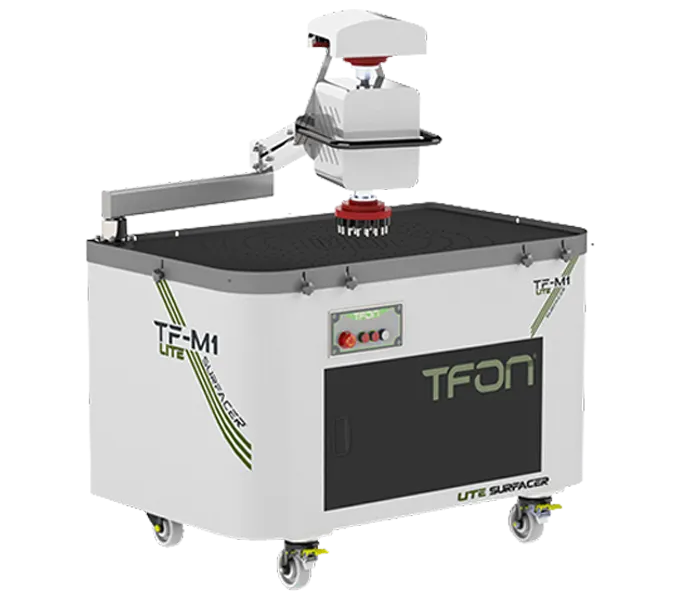
TFON builds this step as the Lite Surfacer. The TF-M1 LITE H1 has one processing head and the TF-M1 LITE H2 has two. Both share the same working range:
- material thickness from 3 to 200 mm, from sheet to heavy plate;
- parts up to 800 mm wide and 1,500 mm long, with a minimum size of 80 x 80 mm;
- an 800 x 1300 mm table with vacuum holding;
- a machine power consumption of 5.5 kW.
The heads take quick-change discs for each job: the Heavy Slag Removal Disc for plasma and oxy-fuel slag, the Deburring Disc, the Oxide Removal Disc, the Edge Rounding Disc and the Finishing Disc. One machine therefore covers slag, burrs, oxide, edges and a satin finish, one operation at a time. Stainless steel should be processed with its own set of discs.
Before buying a manual machine, check that the table and holding suit your smallest and largest parts, how long a disc change takes, how dust is extracted and whether you need a separate disc set for stainless steel.
The limits are clear. The result depends on the operator, so if repeatability is a written acceptance criterion, an automatic configuration is the right tool. The Lite Surfacer suits prototypes, mixed low-volume batches, post-weld rework and corrections before assembly, and it often stays in use next to an automatic line for the parts the line does not take. The manual deburring and edge rounding machines page compares the two models.
Tool or Machine for Holes, Plate, Stainless and Small Parts
The general rule, hand tools for low volume and machines for repeat parts, bends for some jobs. These are the cases that come up most often in sheet metal shops.
Holes and internal cut-outs
By hand, every hole needs its own countersink or blade work on both faces. On a machine, a flat belt passes over holes without touching their edges, while brush and flap wheel stations reach into the openings and round the edges on the processed face. Parts with many holes are often where a machine with edge rounding stations saves the most hand time.
Heavy plate and slag
Plasma and oxy-fuel cut plate with dross is usually ground by hand, which is slow and hard on operators. A manual machine with a Heavy Slag Removal Disc, or a through-feed machine with a heavy slag station such as the TF-RBC series, breaks the deposit off instead of grinding it. The guide on slag vs dross explains why slag needs a different first step than a burr.
Stainless steel with a visible face
Hand pads and discs leave uneven marks, and shared abrasives contaminate the surface. A machine with stainless-only consumables and a finishing station gives the same grain on every part.
Very small or very long parts
Machines have limits. TFON Surfacer machines publish a minimum part size of 50 x 50 mm, depending on holding and geometry, and the Lite Surfacer 80 x 80 mm. Smaller parts stay with hand tools or go to mass finishing. Long parts beyond a manual table suit a through-feed machine, where the conveyor carries the part.
Operator Safety and Ergonomics
The safety case for a machine is often as strong as the cost case, and it is easier to see on the shop floor.
- Cuts. Burrs and sharp edges cause lacerations during handling, and hand deburring means touching every edge. Cut-resistant gloves, rated in the US under ANSI/ISEA 105, reduce the risk but slow fine work.
- Hand-arm vibration. Angle grinders and die grinders transmit vibration to the hands for as long as the job lasts. ISO 5349 and ANSI S2.70 describe how that exposure is measured. The simplest control is to reduce grinding time.
- Dust and sparks. Grinding produces metal dust. Aluminum dust is combustible and must not be collected together with steel grinding dust, and stainless steel work needs its own abrasives.
- Noise and repetitive strain. Long grinding sessions add noise exposure and repetitive wrist and shoulder load.
A machine moves the operator away from the contact point. On a through-feed machine, the operator loads and unloads parts while guarding encloses the belts and brushes. On a manual machine, the operator guides the part on a table rather than holding a grinder. Neither removes the need for gloves when handling sharp incoming parts, eye protection and dust extraction, but both cut the hours of direct exposure.
That reduction is also a staffing argument. Hand deburring is hard to recruit for and hard to keep staffed, and moving it to a machine frees skilled people for fitting and welding.
How to Move from Hand Tools to a Machine
Shops rarely replace hand deburring in one step. A staged change keeps production running and shows early whether the machine does what the trial promised.
- Write down the edge requirement for your main parts: burr-free only, or a radius, oxide removal, a finish. Without it, nobody can say whether the machine result is good enough.
- Time the current work on your highest-volume parts, including turning, inspection and rework. This is the baseline the machine has to beat.
- Sort parts by route. Flat repeat parts go to a through-feed machine; mixed and awkward parts to a manual machine or hand tools; assemblies stay with the grinder.
- Run a trial with an ordinary part and the most difficult one, and record settings, passes and results for both faces.
- Train more than one operator and store the settings, so the result does not depend on one person.
- Keep the hand tools for rework and the odd part the machine does not take.
For flat repeat parts, a machine such as the TF-RB-2510 combines belt deburring and edge rounding for parts up to 1,000 mm wide; the full range is on the deburring and edge rounding machines page.
TFON Machines for This Job
-
TFON Lite Surfacer® TF-M1 LITE H1
Manual single-head deburring machine: 3 to 200 mm thickness, 800 x 1300 mm vacuum table, 5.5 kW
Specifications Request a Quote -
TFON Lite Surfacer® TF-M1 LITE H2
Manual two-head deburring machine: 3 to 200 mm thickness, parts up to 800 x 1500 mm, vacuum holding
Specifications Request a Quote -
TFON Surfacer® TF-RB-2510
1,000 mm through-feed machine; belt deburring and edge rounding in one pass for repeat parts
Specifications Request a Quote
Frequently Asked Questions
What can be used in place of a deburring tool?
For a few parts, a fine file, a countersink bit turned by hand, sandpaper on a block or a non-woven pad will remove light burrs. A utility knife is not a safe substitute. For repeat production, the practical alternative is a manual or through-feed deburring machine rather than improvised hand tools.
How do you use a swivel deburring tool?
Hold the handle at a steady angle, place the hooked blade on the edge and pull it along in one smooth stroke, letting the blade swivel to follow the contour. For holes, run it around the rim. Stop once the burr is gone; extra strokes cut a chamfer.
Is an angle grinder a deburring tool?
It can be. With a flap disc or non-woven wheel, an angle grinder removes heavy burrs and dross on plate. It is fast but hard to control on thin sheet, where it easily gouges the edge, and it exposes the operator to vibration, noise and dust.
Does a manual deburring machine give repeatable results?
Only as repeatable as the operator. A manual machine such as the TFON Lite Surfacer makes the work faster and more consistent than hand tools, but the result still depends on how the part is guided. Where repeatability is a written requirement, an automatic through-feed machine is the right choice.
Can the Lite Surfacer remove slag from plasma cut parts?
Yes. The TF-M1 LITE H1 and H2 take the Heavy Slag Removal Disc, a Ø150 mm disc with rubberized pins that breaks slag off the edges of oxy-fuel and plasma cut parts. Other discs then handle deburring, oxide removal, edge rounding and finishing.
Let Us Review Your Part
Share the material, cutting method, part dimensions and the next operation, with photos of both faces. We will recommend the machine and station sequence that fits the part.