

Knowledge Base
Sheet Metal Finishing Glossary
A sheet metal finishing glossary collects the terms used for what happens to a part after cutting: burrs, dross and oxide on the edges, edge breaks and radii, weld bevels, surface roughness, flatness, and the machines and consumables that produce each result. Each entry gives a short definition and links to a detailed guide.
TFON Machines for This Job
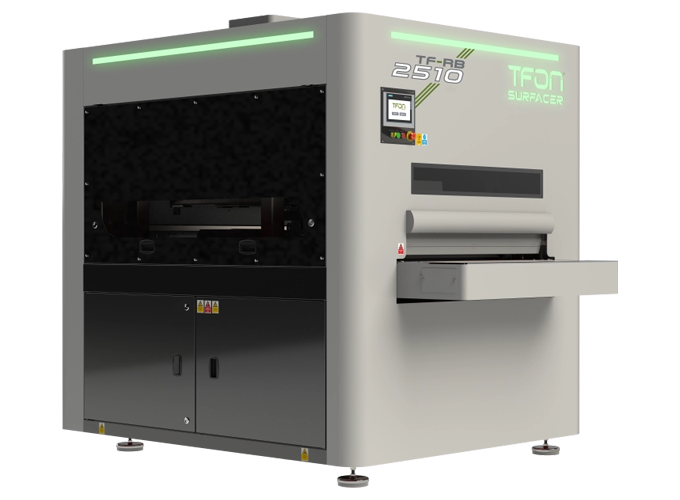
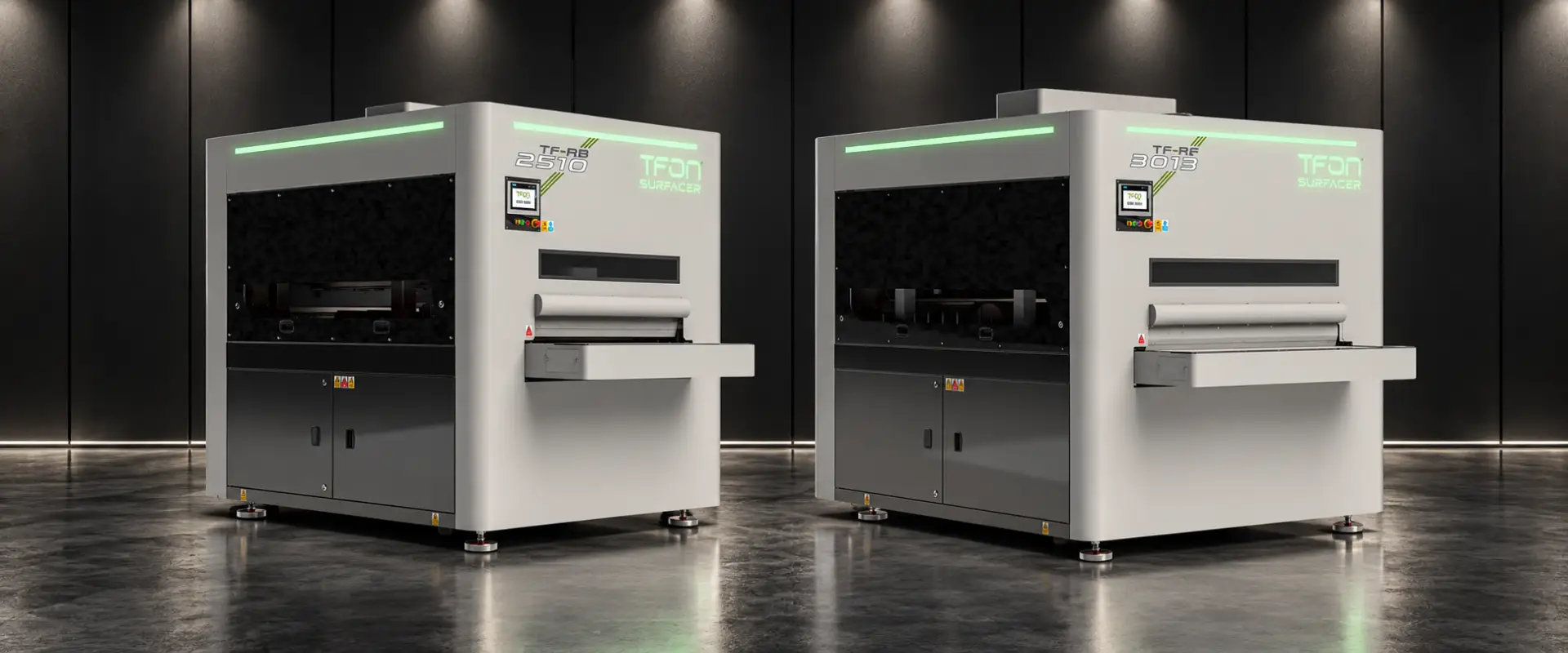
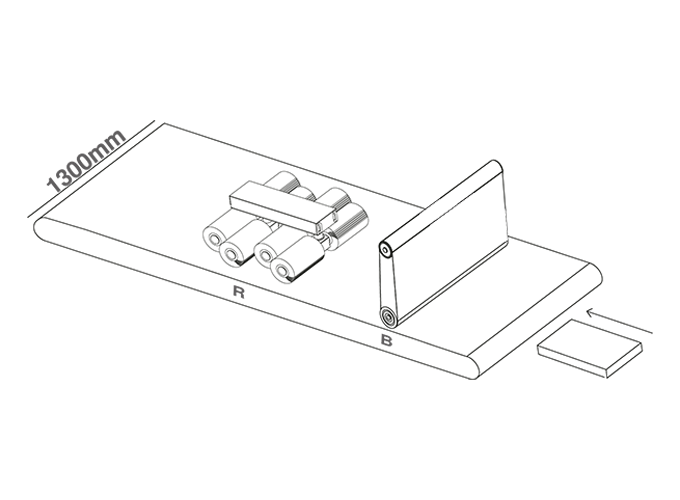
- TFON Surfacer® TF-RB-3013 Deburring machine; 1,300 mm working width; abrasive belt plus 8 flap wheels (Ø350 mm); conveyor 0.6-4.0 m/min Specifications Request a Quote
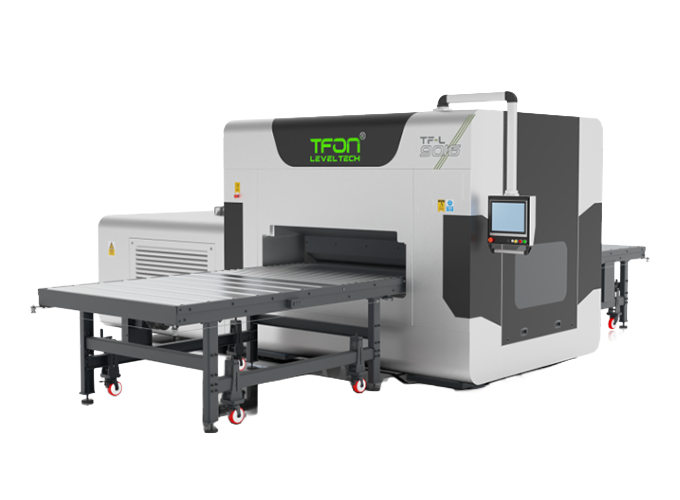
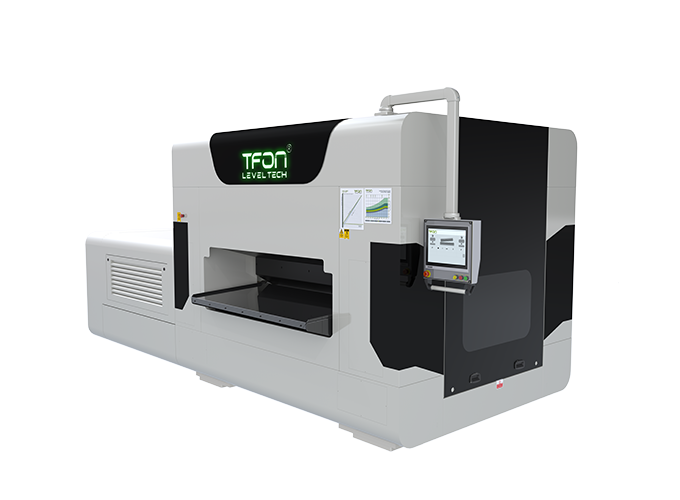
- TFON Leveltech® TF-M 5513 Leveling machine; 0.5-15 mm material thickness; 1,300 mm maximum width; servo hydraulic / PC gap control Specifications Request a Quote
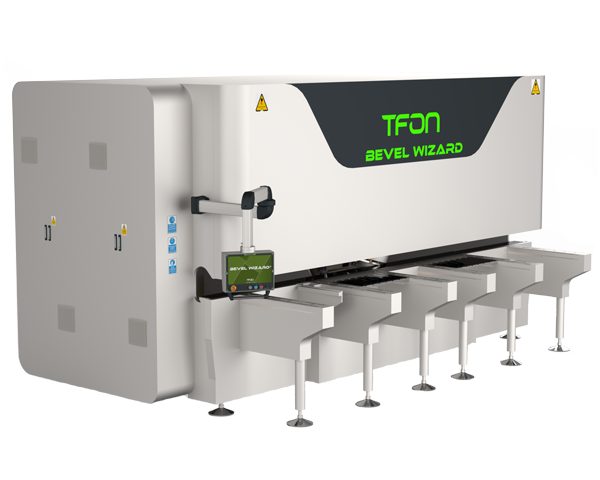
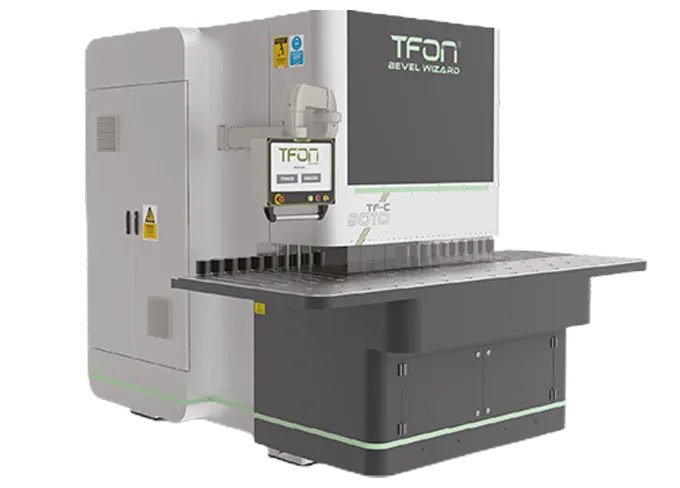
- TFON Bevel Wizard® TF-C 8010 L Plate beveling machine; 4-100 mm part thickness; -30° to +80° working angle; parts up to 12,000 mm long Specifications Request a Quote
How to Use This Glossary
This glossary covers the terms that come up when a cut sheet metal or plate part is prepared for its next step: removing burrs, dross and oxide from the edges, rounding edges for coating, finishing surfaces, flattening parts and preparing plate edges for welding. It is written for the people who specify, buy and run that work: production managers, quality and welding engineers, and buyers comparing machines.
Terms are listed alphabetically. Each entry gives a short definition, says why the term matters on the shop floor and links to the page that covers it in depth. Where a term has a standard definition, the entry follows it: welding joint terms follow AWS A3.0 usage, roughness terms follow ISO 21920 and ASME B46.1, and stainless steel finish names follow ASTM A480.
Figures quoted for TFON machines and consumables come from TFON's published technical data. For the processes behind the terms, start with sheet metal deburring, edge rounding, leveling and plate beveling. The full set of guides is in the TFON Knowledge Base.
A
- Abrasive belt
An abrasive belt is a continuous loop of coated abrasive, with grain bonded to a cloth or film backing, that runs over a contact drum and removes material from the part. In sheet metal deburring machines, a wide belt takes the burr off the top edge and sets the scratch pattern of the surface. TFON supplies abrasive belts from 680x1820 mm to 1630x1820 mm, in grits 40-400, and Cubitron belts in grits 24-400.
- Abrasive grain
The abrasive grain is the cutting mineral on a belt, disc or flap brush. Aluminum oxide is a general-purpose grain, while zirconia and ceramic grains fracture in use to expose fresh cutting edges, which suits heavier stock removal and harder materials. TFON's aluminum oxide and zirconium belts are rated for up to 32 hours of service, ceramic belts for up to 64 hours and Cubitron belts for up to 80 hours. See sheet metal surface finishing for how grain and grit shape the result.
- Assist gas
Assist gas is the gas blown through a laser cutting nozzle together with the beam. Oxygen reacts with carbon steel and leaves an oxide layer on the cut face, nitrogen is inert and leaves a bright edge, and compressed air sits between the two. The choice decides whether the edge needs oxide removal later; see oxygen vs nitrogen laser cutting.
B
- Backup rolls
Backup rolls support the work rolls of a roller leveler along their length so they do not deflect under load. On many levelers they can be adjusted in sections across the width, which lets the machine correct edge wave and center buckle as well as a simple bow. Our sheet metal leveler buying guide explains how roll layout relates to thickness range.
- Bevel angle
In welding, the bevel angle is the angle between the prepared edge of one joint member and a plane perpendicular to the surface of that member, as defined in AWS A3.0. In a single-V groove with both members beveled equally, the groove angle is twice the bevel angle. TFON Bevel Wizard machines have a working angle range of -30° to +80°; see weld bevel and groove types.
- Beveling
Beveling, or weld edge preparation, cuts an angled face on the edge of a plate so that a groove weld can reach through the joint thickness. It is a different operation from chamfering, which only removes a sharp corner. TFON Bevel Wizard machines for plate beveling prepare plate and sheet edges from 4 to 100 mm thick; they are not built for pipe.
- Burr
A burr is a thin ridge of material that projects from the edge of a part after punching, shearing, laser or plasma cutting, or machining. Burrs cut hands, damage seals, stop parts from sitting flat and hold coatings poorly. Our guide explains what a burr is and how it forms.
- Burr height
Burr height is how far a burr projects beyond the surface of the part, measured with a height gauge, dial indicator or optical instrument. Drawings often set a maximum burr height or simply call for sharp edges to be broken. Sheet metal deburring machines bring burr height down in a controlled, repeatable way.
C
- Center buckle
Center buckle is a flatness defect in which the middle of a sheet or part is longer than its edges, so the center rises in waves while the edges stay flat. A roller leveler with adjustable backup rolls corrects it by working the edges harder than the center. See sheet metal leveling for how flatness defects are treated.
- Chamfer
A chamfer is a small angled cut that removes a sharp corner, usually given as a length and an angle, such as 0.5 mm x 45°. It breaks an edge for handling or assembly and is not a weld preparation; a weld bevel is sized to the joint and the plate thickness. For weld preparation terms, see weld bevel and groove types.
- Coil set
Coil set is the lengthwise curvature a sheet keeps from being wound in a coil. It shows up as a part that curls along its length after decoiling or cutting. Straighteners and roller levelers remove it; see the sheet metal leveler buying guide.
- Crossbow
Crossbow is curvature across the width of a sheet, at right angles to the rolling direction. It often appears together with coil set and makes wide parts rock on a flat table. Roller levelers reduce it as part of the leveling cycle, with results that depend on material and setup; see sheet metal leveling.
D
- Deburring
Deburring is the removal of burrs from the edges of a cut, punched or machined part, usually followed by breaking the sharp edge. On flat sheet metal parts it is done by hand, by tumbling, or on through-feed machines with abrasive belts and brushes. See sheet metal deburring for the methods and machines.
- Dross
Dross is molten metal and oxide that resolidifies on the bottom edge of a thermally cut part, typically after plasma, oxy-fuel or laser cutting. On the shop floor it is often called slag. Heavy dross needs its own removal step before deburring; see slag vs dross.
E
- Edge break
An edge break is a small removal of material at a sharp corner, enough to make the part safe to handle, without an exact radius or chamfer size. Drawings often state it as a note to break all sharp edges, sometimes with a maximum size. Where a coating needs a defined radius, specify edge rounding instead.
- Edge radius
Edge radius is the defined curvature of a rounded edge, checked with radius gauges, a profile projector or an optical instrument. Coating specifications often call for a minimum radius so that paint and powder can wrap the edge. TFON's page on sheet metal edge rounding explains why no single radius suits every part.
- Edge rounding
Edge rounding produces a defined radius on the edges of a part, usually with rotating flap brushes or edge rounding discs. It prepares edges for coating and makes parts safer to handle. TFON Surfacer and Lite Surfacer models round the edges of flat parts; see the deburring and edge rounding machines.
- Edge wave
Edge wave is a flatness defect in which the edges of a sheet are longer than its center, so the edges ripple while the middle lies flat. It is the opposite of center buckle. Levelers correct it by working the center harder than the edges; see the sheet metal leveler buying guide.
F
- Feed rate
Feed rate is the speed at which parts travel through a through-feed machine, given in meters per minute. Slower feed means more contact time with each tool and a stronger effect per pass. TFON Surfacer conveyors run at 0.6-4.0 m/min and Bevel Wizard machines feed parts at 1.0-4.0 m/min; the machine comparison lists values by model.
- Flame straightening
Flame straightening corrects distortion by heating small, selected areas with a torch and letting restrained shrinkage pull the part back into shape. It suits large weldments that cannot pass through a leveler, but it depends on operator skill, and codes such as AWS D1.1 limit the temperature of heated areas. See stress relief after welding for how it compares with other methods.
- Flap brush
A flap brush, also called a flap wheel or flap roll, is a rotating tool built from many abrasive flaps arranged around a core. In deburring machines, sets of flap brushes rotate over the part to break and round its edges. TFON edge rounding flap brushes come in Ø270x250, Ø300x400 and Ø350x490 mm sizes and grits 60-400, with a service life of up to 1,500 hours depending on use.
- Flatness
Flatness is a form tolerance: the distance between two parallel planes that contain the entire surface. It has to be measured with the part in a defined condition, because a part clamped flat can spring away when released. Flatness of sheet and plate parts is corrected by sheet metal leveling.
G
- Grit
Grit is the size designation of an abrasive grain; a higher number means a finer grain. Coated abrasives are graded under FEPA P-grades in Europe and ANSI/CAMI grades in the US, and the two scales differ at fine sizes. Grit alone does not define a finish or an Ra value; see surface roughness Ra and Rz.
- Groove angle
The groove angle is the total included angle of the groove between the parts to be joined. In a single-V groove with both members beveled, it is the sum of the two bevel angles. See weld bevel and groove types for typical angles by groove type.
- Groove weld
A groove weld is a weld made in the groove between two workpieces, usually after their edges have been prepared with a V, bevel, J or U profile. Groove welds can fuse through the full thickness of plate, which a fillet weld cannot. See weld bevel and groove types.
H
- Heat-affected zone (HAZ)
The heat-affected zone is the band of base metal next to a weld or thermal cut whose microstructure and properties were changed by heat without melting. In hardenable steels it can become hard and brittle, which is one reason codes call for postweld heat treatment. See stress relief after welding.
- Heavy slag removal disc
A heavy slag removal disc is a rotating disc with rubberized pins that knocks thick slag and dross off plasma and oxy-fuel cut parts. TFON's version is Ø150 mm, runs at 700 rpm and is used on TF-RBC Surfacer models and Lite Surfacer machines. See the slag removal machine page.
K
- Kerf
The kerf is the slot of material removed by a cutting process such as a laser beam, plasma arc or saw. Its width and the condition of its walls (striations, oxide, dross) decide how much edge work the part needs afterward. See laser-cut and punched parts.
L
- Lay
Lay is the direction of the dominant surface pattern, such as the grain of a brushed finish. Drawings show it with symbols (=, ⊥, X, M, C, R, P), and roughness is normally measured across it. See surface roughness Ra and Rz.
- Leveling gap
The leveling gap is the opening between the upper and lower work rolls of a roller leveler, set at the entry and exit to control how deeply the part is bent. On TFON Leveltech machines it is adjusted by servo mechanics on the XS and TF-S series and by servo hydraulics with PC control on the TF-M and TF-L series. See the Leveltech leveling machines.
M
- Magnetic conveyor
A magnetic conveyor holds steel parts in place with magnetic force while they pass under the processing stations. It keeps small and thin steel parts still without clamps, but it cannot hold aluminum or austenitic stainless steel, which need vacuum holding. TFON Surfacer machines offer vacuum and/or magnetic part holding; see the deburring and edge rounding machines.
- Mill scale
Mill scale is the dark iron oxide layer that forms on steel during hot rolling. It is removed by pickling, blasting or grinding before most coatings and before finishing visible surfaces. See types of metal finishes.
N
- No. 4 finish
No. 4 is the general purpose polished stainless steel finish in ASTM A480: a linear, directional texture with Ra generally up to 25 µin (about 0.64 µm). Its look varies between suppliers, so matching parts are ordered against a reference sample. See types of metal finishes.
- Non-woven abrasive
A non-woven abrasive is a three-dimensional web of synthetic fibers with abrasive grain bonded throughout. It removes little material and is used to refine a scratch pattern into a satin finish or to clean a surface without changing its dimensions. TFON's Scotch non-woven abrasives come in coarse, medium, fine and very fine grades, with a service life of up to 64 hours.
O
- Oxide layer
In sheet metal cutting, the oxide layer is the thin, dark iron oxide film left on the cut face when steel is laser cut with oxygen or air. Powder coat and paint bonded to it can chip off when the oxide separates from the steel. See laser oxide removal.
- Oxide removal brush
An oxide removal brush is a rotating wire brush that cleans oxide from the cut faces of laser-cut parts. TFON's version has a flexible wire structure, comes in Ø300 and Ø350 mm sizes and lasts up to 250 hours; it runs on all TFON Surfacer models. See discs and brushes.
P
- Parts leveler
A parts leveler is a roller leveler built for individual cut parts, such as laser-cut, plasma-cut and punched blanks, rather than coil. Minimum part length and the handling of holes and cutouts matter more than on a coil line. See the Leveltech leveling machines.
- Profilometer
A profilometer is an instrument that measures surface texture. A contact profilometer draws a diamond stylus across the surface, while optical instruments measure without touching it. Results depend on stylus, cutoff and direction; see surface roughness Ra and Rz.
R
- Ra
Ra is the arithmetic mean deviation of the roughness profile from its mean line, the default roughness parameter on most drawings. It is given in micrometers in ISO practice and in microinches in US practice. See surface roughness Ra and Rz.
- Residual stress
Residual stress is stress locked in a part with no outside load acting on it, left by rolling, cutting, welding or forming. When it is released unevenly, parts bow, twist or move during machining. See stress relief after welding.
- Roller leveler
A roller leveler is the machine that flattens sheet, plate and cut parts by bending them up and down between staggered work rolls with decreasing penetration. It removes curvature and evens out residual stress, but it does not replace a stress-relief heat treatment. See the sheet metal leveler buying guide.
- Root face
The root face, also called the land, is the unbeveled portion of a prepared edge at the joint root, as defined in AWS A3.0. It supports the root pass and helps control burn-through. See weld bevel and groove types.
- Root opening
The root opening is the separation between the workpieces at the joint root, often called the gap on the shop floor. Together with the root face and groove angle, it controls penetration at the root of the weld. See weld bevel and groove types.
- Rz
Rz is the maximum height of the roughness profile: the highest peak plus the deepest valley within a sampling length, averaged over several sampling lengths. Older ISO and Japanese standards use the same symbol for the ten-point height, so check which definition a drawing means. See surface roughness Ra and Rz.
S
- Sampling length
The sampling length is the section of the profile over which roughness parameters are evaluated, numerically equal to the cutoff wavelength λc. The default evaluation length is five sampling lengths, for example 5 x 0.8 mm for Ra between 0.1 and 2 µm. See surface roughness Ra and Rz.
- Satin finish
A satin finish is a fine, directional finish with a soft sheen, produced with fine abrasive belts followed by non-woven abrasives. It is common on visible stainless steel panels; ASTM A480 describes No. 6 as a dull satin finish. See sheet metal surface finishing.
- Slag
Slag is the nonmetallic residue left by welding fluxes and metal production; in cutting shops the word is also used for the dross on thermally cut edges. Heavy slag on plasma and oxy-fuel parts is removed before deburring. See slag removal.
- Station
A station is one processing unit in a through-feed machine, such as an abrasive belt, a set of rotating flap brushes or a heavy slag disc unit. The number and type of stations decide what a machine can do in one pass. TFON Surfacer model names show the station combination; see the machine comparison.
- Stress-relief heat treatment
A stress-relief heat treatment heats a welded part below its transformation temperature, holds it and cools it slowly to relax residual stresses; for carbon steel, codes typically call for about 1100-1200°F (595-650°C). It is the method welding codes specify when postweld heat treatment is required. See stress relief after welding.
- Surface roughness
Surface roughness is the fine, closely spaced texture a process leaves on a surface, measured as a profile of peaks and valleys. It is separated from waviness and form by filtering and reported with parameters such as Ra and Rz. See surface roughness Ra and Rz.
V
- Vacuum table
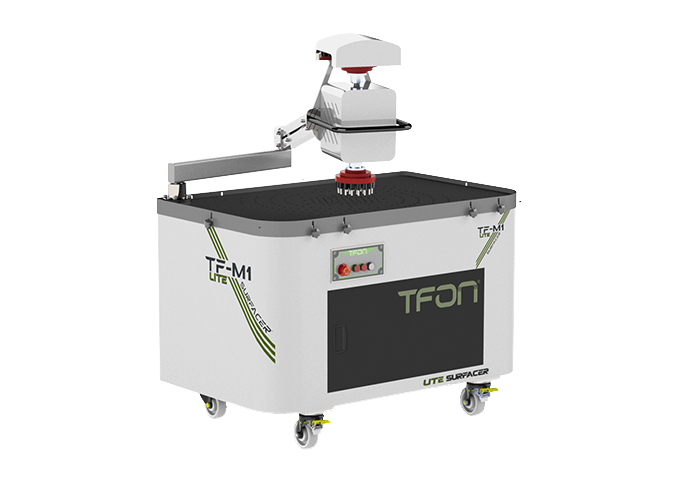
A vacuum table holds parts on a machine by suction through a perforated surface, so it also holds nonmagnetic materials such as aluminum and austenitic stainless steel. TFON Lite Surfacer machines use vacuum holding on an 800 x 1,300 mm table; see the TF-M1 LITE H1 manual deburring machine.
- Vibratory finishing
Vibratory finishing processes parts in a bowl or tub of abrasive media that vibrates, so the media works on all surfaces and edges at once. It suits small parts in bulk; TFON does not build vibratory machines. See vibratory vs belt and brush deburring.
- Vibratory stress relief
Vibratory stress relief treats a weldment by vibrating it at or near resonance to lower peak residual stresses. It is used on machine frames before machining, but welding codes do not accept it in place of thermal stress relief. See stress relief after welding.
W
- Work rolls
Work rolls are the rolls of a leveler that contact the part and bend it. Their diameter and pitch set the thickness range: small rolls at close pitch for thin sheet, larger rolls at wider pitch for plate. The TF-M 5513 leveling machine, for 0.5-15 mm material, is a mid-range example.
- Working width
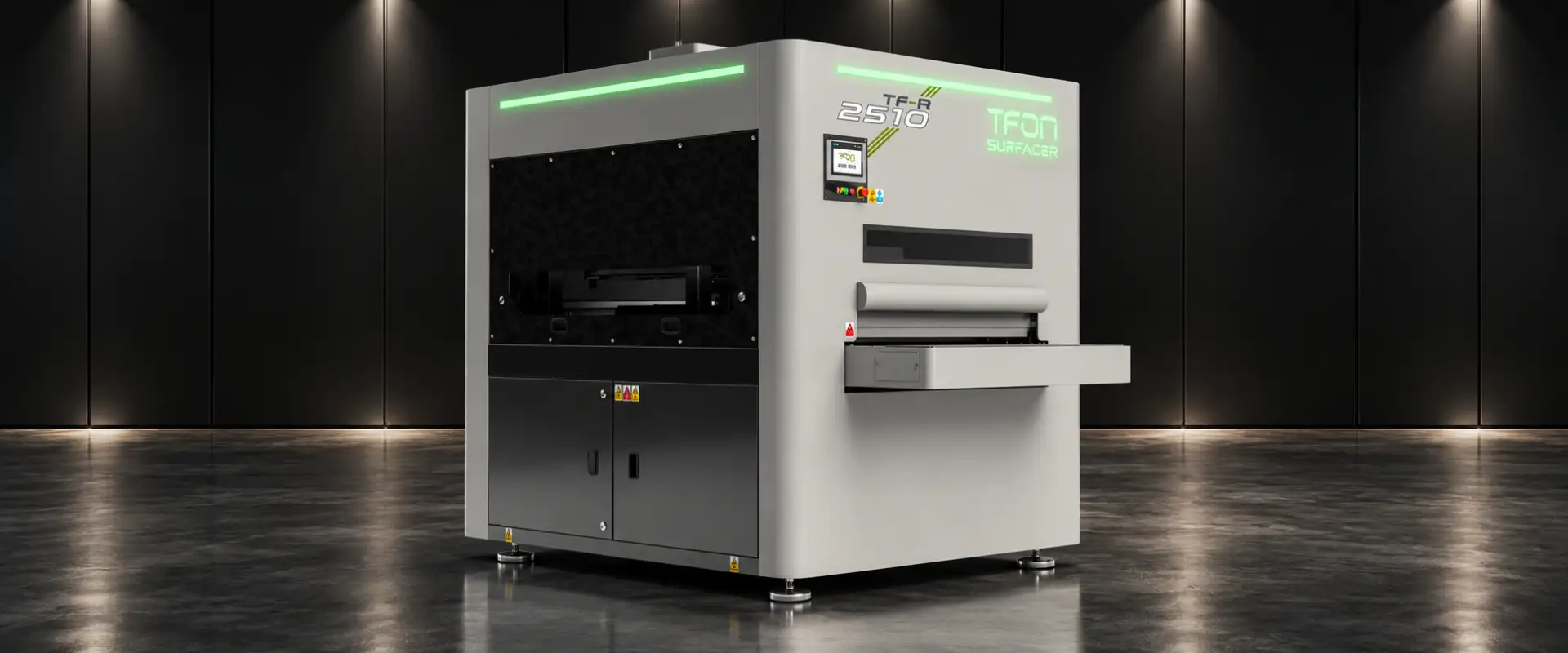
Working width is the maximum part width a machine can process in one pass. TFON Surfacer machines have a working width of 1,000 mm (2510 series) or 1,300 mm (3013 series), Lite Surfacer tables are 800 mm wide, and Leveltech machines range from 200 mm to 2,000 mm. The TF-RB-2510 deburring machine is a 1,000 mm example.
TFON Machines for This Job
-
TFON Surfacer® TF-RB-3013
Deburring machine; 1,300 mm working width; abrasive belt plus 8 flap wheels (Ø350 mm); conveyor 0.6-4.0 m/min
Specifications Request a Quote -
TFON Leveltech® TF-M 5513
Leveling machine; 0.5-15 mm material thickness; 1,300 mm maximum width; servo hydraulic / PC gap control
Specifications Request a Quote -
TFON Bevel Wizard® TF-C 8010 L
Plate beveling machine; 4-100 mm part thickness; -30° to +80° working angle; parts up to 12,000 mm long
Specifications Request a Quote
Frequently Asked Questions
What is the difference between a burr and dross?
A burr is a thin ridge of the part's own material left projecting from an edge by punching, shearing, laser cutting or machining. Dross is molten metal and oxide that resolidified on the bottom edge of a thermally cut part. Burrs are removed by deburring; heavy dross usually needs a separate slag removal step first.
What is the difference between an edge break and an edge radius?
An edge break removes just enough material at a sharp corner to make it safe, without a defined size or shape. An edge radius is a specified curvature, such as a minimum radius required by a coating specification, and it is measured. Use edge break for handling safety and a radius when coating coverage or function depends on it.
What does root face mean in welding?
The root face, also called the land, is the flat, unbeveled part of a prepared plate edge at the root of the joint. It supports the root pass and helps prevent burn-through. Its size is chosen together with the bevel angle and the root opening, according to the welding procedure and the plate thickness.
What is the difference between leveling and straightening?
Leveling passes a flat part through a roller leveler that bends it past yield in alternating directions, treating the whole part and evening out residual stress. Straightening corrects distortion locally, with a press or with controlled heat, and suits weldments and parts too large for a leveler. Neither replaces a stress-relief heat treatment.
What is a flap brush used for?
In sheet metal finishing, a flap brush is a rotating tool made of many abrasive flaps. Sets of flap brushes in a deburring machine break and round the edges of cut parts, including many inner contours, and can also blend the surface. TFON edge rounding flap brushes come in grits 60-400 and three sizes up to Ø350x490 mm.
Let Us Review Your Part
Share the material, cutting method, part dimensions and the next operation, with photos of both faces. We will recommend the machine and station sequence that fits the part.