

Roller leveling improves the flatness of suitable sheet metal, plate and cut parts through controlled alternating bending. The process is selected from the material, incoming distortion and required result. A part that can be forced flat in a fixture may still need a flatness review in its specified inspection condition.
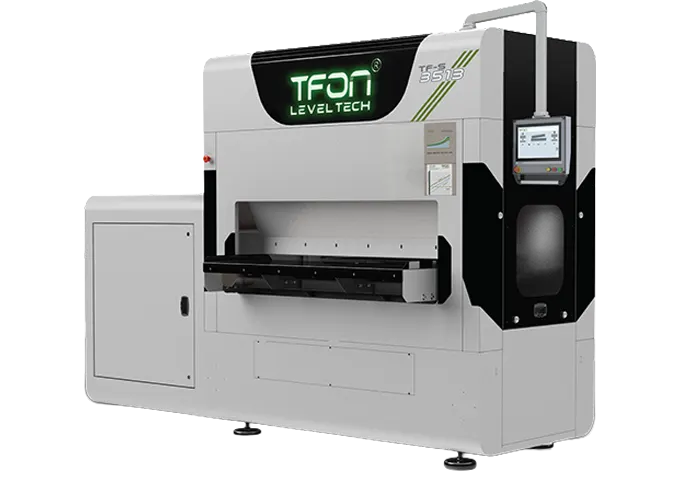
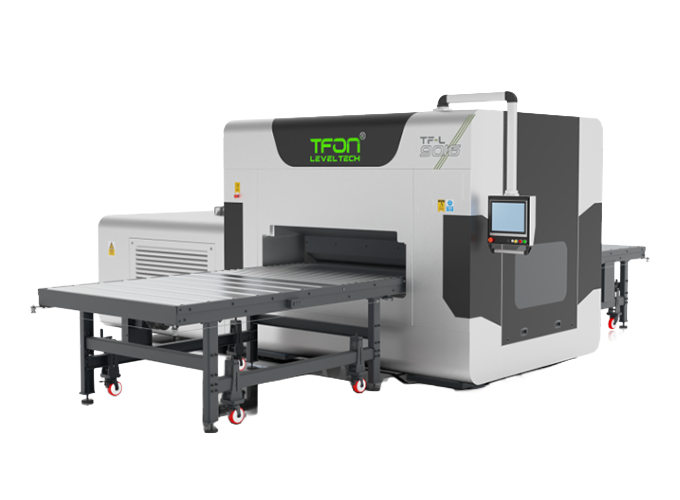
TFON Leveltech machines address mechanical leveling before further fabrication. Their suitability must be considered for the actual strength, dimensions and geometry of the workpiece.
Identify When the Part Changes Shape
Distortion may be present in incoming sheet, become visible after cutting or develop during later fabrication. Compare the part before and after the operation where its shape changes. This helps distinguish an incoming flatness defect from deformation introduced later in the production route.
Bow, waves and local distortion do not describe identical problems. Record where the deviation occurs, how the part is supported during inspection and whether cut-outs or narrow sections influence its shape. For a detailed investigation, read what causes sheet metal warping.
How Roller Leveling Works
The workpiece passes between offset rollers that bend it in alternating directions. The selected roller arrangement and settings act on the material to improve its shape. Material properties, thickness, width and part geometry influence the required process and the achievable result.
Mechanical leveling can change the residual-stress distribution. It should not be treated as proof that every internal stress has been removed or that the part cannot distort during subsequent cutting or welding.
Mechanical leveling and thermal stress relief
Thermal stress-relief treatment uses a controlled heat-treatment route for an appropriate material and requirement. Roller leveling is a mechanical process. One should not be substituted for the other without reviewing the engineering requirement.
Specify a Measurable Flatness Requirement
| Input | Why it is needed |
|---|---|
| Material grade and condition | Strength and material response affect selection |
| Thickness, width and length | Establish dimensional screening for the machine |
| Part drawing | Shows openings, narrow sections and relevant features |
| Incoming flatness | Documents the defect before processing |
| Inspection method and support | Makes before/after results comparable |
| Required downstream result | Connects leveling to bending, welding or assembly |
Measure in the condition required by the drawing or inspection procedure. Clamping a part flat during inspection can conceal the shape that matters when it is released.
Compare TFON Leveltech Machines
Explore the TFON Leveltech range and its published model specifications. Use dimensional data to shortlist candidates, then confirm material strength, geometry and the required flatness through an application review.
Review loading, support and unloading as part of the same project. If an incoming edge has burrs or attached residue, discuss deburring and cleaning requirements before establishing the complete machine sequence.
Leveling Questions
Will a leveled part always stay flat after welding?
No. Welding introduces new heat and shrinkage effects. The welding sequence, restraint and inspection requirements still need to be controlled.
Is thickness enough to choose a model?
No. Material strength, width, geometry and the incoming shape also influence suitability.
What demonstrates an acceptable result?
Comparable before-and-after measurements on representative parts, using the agreed method and support condition, provide a practical basis for evaluating the trial.