

Consumables
Abrasive Belts
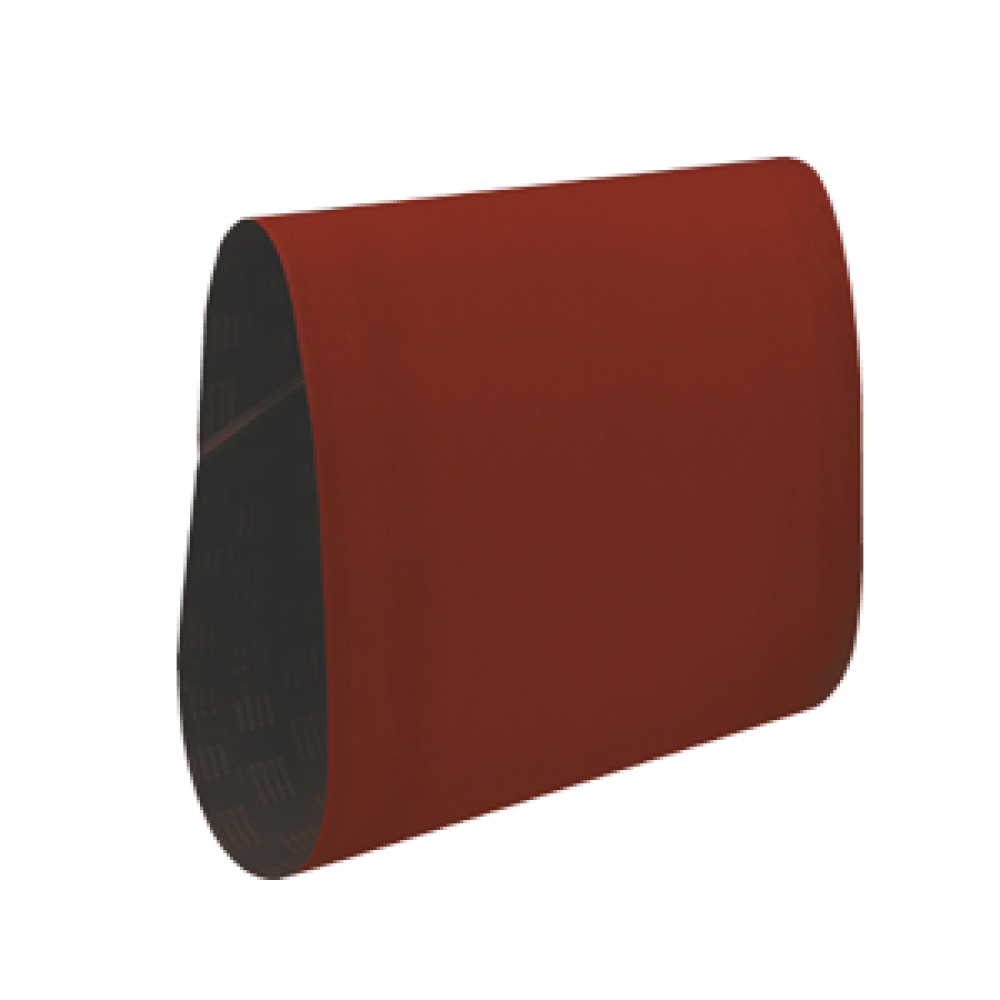
An abrasive belt is a flexible backing coated with abrasive grain and joined into an endless loop. In a deburring machine the belt runs over a contact drum and removes cutting burrs from the part. TFON supplies ceramic, zirconia, aluminum oxide and Cubitron belts in four sizes, from 680 x 1820 mm to 1630 x 1820 mm.
Used on These TFON Machines
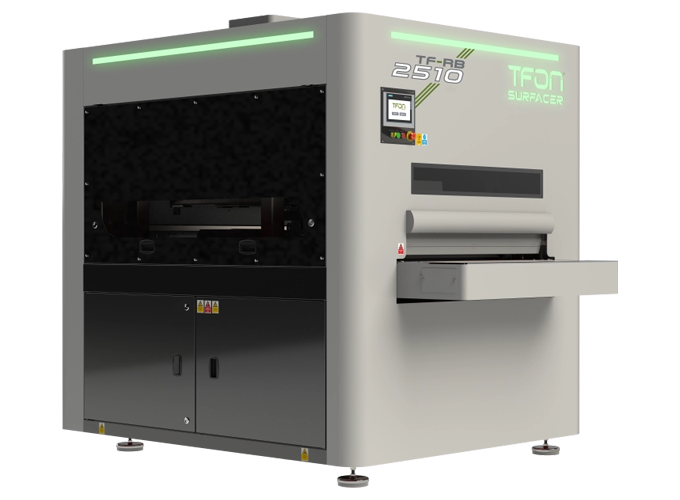
- TFON Surfacer® TF-RB-2510Deburring machine
- TFON Surfacer® TF-RBC-2510Slag removal and deburring machine
- TFON Surfacer® TF-RBF-2510Deburring and finishing machine
- TFON Surfacer® TF-RF-2510Surface finishing machine
- TFON Surfacer® TF-RB-3013Deburring machine
- TFON Surfacer® TF-RBC-3013Slag removal and deburring machine
- TFON Surfacer® TF-RBF-3013Deburring and finishing machine
- TFON Surfacer® TF-RF-3013Surface finishing machine
What Is an Abrasive Belt and What Does It Do?
An abrasive belt is made by bonding abrasive grain to a cloth or similar flexible backing with resin. The material is cut to machine size and joined at the ends into an endless belt. Every belt therefore has a splice, and most carry an arrow on the back that shows the running direction.
In sheet metal work the belt does two jobs: it removes the cutting burr and it leaves an even sanded texture on the face. In a deburring machine the goal is not to remove thickness. It is to take the burr off the cut edge without damaging the surface. That is the main difference from wide-belt calibrating sanders used on wood and panels.
On TFON Surfacer machines the belt runs in the deburring (B) and satin finish (F) stations. It is pressed onto the part over a contact drum. An electropneumatic oscillation system (AutoSwing) keeps the belt moving side to side, so it does not walk off the drum and lasts longer. See how this station works on deburring laser-cut and punched parts, and the process overview on sheet metal deburring.
Belt Construction: Grain, Backing and Coat
Three things decide how a belt behaves. The first is the grain type, covered in the next section. The second is the backing: cloth backings are graded by flexibility with letters such as J, X and Y, and wide machine belts need a strong cloth or polyester backing. The third is the coat. In a closed coat, grain covers the whole surface and the belt cuts harder. In an open coat, gaps between grains hold the chips, so the belt loads more slowly.
Types of Abrasive Belts
Abrasive belts are grouped first by grain. The grain decides how fast a belt cuts a given metal, how much heat it produces and how long it lasts. Our range covers four grain types.
| Belt | Grain behavior | Strong at | Service life |
|---|---|---|---|
| Aluminum oxide | General-purpose grain; cuts at low to medium pressure | Light burrs on carbon steel, fine textures in higher grits | Up to 32 hours depending on use |
| Zirconia | Tough grain; fractures under high pressure and exposes new cutting points | Pronounced burrs on carbon and stainless steel | Up to 32 hours depending on use |
| Ceramic | Microcrystalline grain; breaks in small pieces, stays sharp and cuts cooler | Stainless and alloy steel, high-volume deburring | Up to 64 hours depending on use |
| Cubitron | Ceramic-based grain; coarse options down to 24 grit | Heavy burrs, long production runs | Up to 80 hours depending on use |
Zirconia is a self-sharpening grain, but only under pressure. At low pressure the grain does not fracture, the belt glazes and stops cutting. Use zirconia where the station applies firm pressure to the part. Ceramic grain stays sharp at lower pressure and produces less heat, which is why ceramic belts are less likely to leave blue and yellow heat tint on stainless steel.
In our order form the zirconia belt is listed as the zirconium belt. Silicon carbide belts are also on the market; they are used on stone, glass and some nonferrous metals, and they are not in our range.
Grit Sizes and How to Choose
The grit number describes the size of the abrasive grain. The higher the number, the finer the grain. Coated abrasives made to European practice use the FEPA P-scale defined in ISO 6344 (P40, P80, P120 and so on). In North America you will also see CAMI grit numbers without the P. The two scales are close in coarse grits and drift apart in fine grits, so quote the P-grade when you order. TFON belts cover 40-400 grit; the Cubitron belt covers 24-400.
- 24-40: coarse. Heavy burrs and high stock removal. 24 grit is available on the Cubitron belt only.
- 60-80: medium coarse. General deburring of laser and plasma parts.
- 100-150: medium. Deburring plus an even surface texture.
- 180-240: fine. Pre-paint surfaces and visible parts.
- 320-400: very fine. Decorative finishes and final passes.
Burr height and target finish pull in opposite directions. A coarse grit clears burrs fast but leaves deep scratches. A fine grit leaves a smooth face but loads and heats up on heavy burrs. For a heavily burred part with a visible face, make the first pass with a coarse belt and the next with a fine one. Our guide to surface roughness Ra and Rz explains how the result is measured.
Belt Sizes for TFON Machines
Belt size is given as width x length. All TFON belts are 1820 mm long; the width follows the working width of the machine.
| Belt | Sizes (mm) | Grit | Service life |
|---|---|---|---|
| Ceramic | 680 x 1820, 1030 x 1820, 1330 x 1820, 1630 x 1820 | 40-400 | Up to 64 hours depending on use |
| Zirconia | 680 x 1820, 1030 x 1820, 1330 x 1820, 1630 x 1820 | 40-400 | Up to 32 hours depending on use |
| Aluminum oxide | 680 x 1820, 1030 x 1820, 1330 x 1820, 1630 x 1820 | 40-400 | Up to 32 hours depending on use |
| Cubitron | 680 x 1820, 1030 x 1820, 1330 x 1820, 1630 x 1820 | 24-400 | Up to 80 hours depending on use |
Surfacer 2510 models take 1030 x 1820 mm belts and 3013 models take 1330 x 1820 mm belts. The 680 x 1820 mm and 1630 x 1820 mm sizes are also in our list; for these, add your machine model and the label of your current belt to the form.
Which Machine and Model?
Abrasive belts run on the eight Surfacer models with a belt station: TF-RB, TF-RBC, TF-RBF and TF-RF. TF-R models have only the edge rounding station and no belt; they run flap brushes and oxide removal brushes.
| Model | Working width | Belt size (mm) | Belt station |
|---|---|---|---|
| TF-RB-2510 | 1000 mm | 1030 x 1820 | B (deburring) |
| TF-RBC-2510 | 1000 mm | 1030 x 1820 | B (deburring) |
| TF-RBF-2510 | 1000 mm | 1030 x 1820 | B (deburring) and F (satin finish) |
| TF-RF-2510 | 1000 mm | 1030 x 1820 | F (satin finish) |
| TF-RB-3013 | 1300 mm | 1330 x 1820 | B (deburring) |
| TF-RBC-3013 | 1300 mm | 1330 x 1820 | B (deburring) |
| TF-RBF-3013 | 1300 mm | 1330 x 1820 | B (deburring) and F (satin finish) |
| TF-RF-3013 | 1300 mm | 1330 x 1820 | F (satin finish) |
On plasma and oxy-fuel parts a belt alone is not enough. The TF-RBC-3013: 1300 mm slag removal and deburring machine breaks the slag at its heavy deburring station first, then the belt takes the burr. For visible parts that need a satin finish, the TF-RBF-2510: 1000 mm deburring and finishing machine is the fit. For heavy plate work, see our slag removal machine page.
Choosing a Belt by Material
No single belt suits every job. The right belt depends on the material, the burr and the finish you need. Use the table as a starting point; we make the final choice with you, based on your part.
| Material and job | Suitable belt | Note |
|---|---|---|
| Carbon steel, laser cut, light burr | Aluminum oxide or zirconia | Medium grit covers most work |
| Carbon steel, plasma and oxy-fuel | Zirconia, ceramic or Cubitron | Break heavy slag first with the heavy slag removal disc |
| Stainless steel | Ceramic or Cubitron | Use dedicated belts; lower heat tint risk |
| Aluminum | Aluminum oxide or ceramic | Loading is the main issue; check the belt often |
| Visible face, final pass | Fine-grit aluminum oxide or non-woven belt | Non-woven for satin finish |
Never run a belt on stainless steel after it has been used on carbon steel. Iron particles stuck to the belt transfer to the stainless surface, and the part shows rust spots later. If you are setting up a stainless line, our stainless steel deburring machine page covers machine and consumable choices together.
Replacement and Service Life
According to TFON data, belt life reaches up to 32 hours for aluminum oxide and zirconia, 64 hours for ceramic and 80 hours for Cubitron, depending on use. Actual life depends on the material, burr height, station pressure and daily running hours.
Replace the belt when:
- Burrs start to remain at the same setting, or you have to slow the feed.
- The belt surface glazes, loses its bite and leaves burn marks on the part.
- Chips load the surface or grain starts to shed.
- The splice opens, the edge tears or the belt develops creases.
Two errors shorten belt life more than any other: a wrong sheet thickness entry and damp storage. The overload protection systems on Surfacer machines (IProtect and GATEWATCH) protect the belt and the contact drum when the entered thickness does not match the part. Store belts in their packaging, in a dry place at room temperature. In a damp store belts curl and splices weaken.
Common Mistakes
- Running zirconia at light pressure: the grain does not fracture, the belt glazes and stops cutting long before it is worn.
- Fine grit on heavy burrs: the belt loads, heats up and leaves burn marks.
- One belt for stainless and carbon steel: rust spots appear on the stainless parts later.
- Skipping the recipe check: wrong thickness and feed settings strain the belt. Automatic thickness measurement reduces this risk, but checking the recipe is still the operator's job.
- Buying on unit price alone: a short-lived belt means more changes, more downtime and more labor.
Ordering
Send your request with the form below; the ceramic, zirconium, aluminum oxide and Cubitron belts are already selected. Untick the types you do not need. Please include:
- Machine model and belt size (for example TF-RBF-3013, 1330 x 1820 mm)
- Belt type and grit, with a quantity for each grit
- Material and cutting method (laser, plasma, oxy-fuel, punching)
You can add non-woven belts for satin finishing and flap brushes for the edge rounding station to the same inquiry.
Request Consumables
Tell us your machine model, the size and the quantity. You can change the selection and add other consumables.
Frequently Asked Questions
What is the best abrasive belt for metal?
There is no single belt for every job. Ceramic or Cubitron suits stainless steel and high-volume work, zirconia suits pronounced burrs on carbon steel, and aluminum oxide suits light burrs and fine finishes. According to TFON data, life reaches up to 32 hours for aluminum oxide and zirconia, 64 for ceramic and 80 for Cubitron, depending on use.
Ceramic vs. zirconia belts: what is the difference?
Both are tough grains for metal, but they behave differently. Zirconia needs firm pressure to fracture and self-sharpen; at low pressure it glazes. Ceramic grain micro-fractures and stays sharp at lower pressure, and it runs cooler, which helps on stainless steel. In TFON data, ceramic belts last up to 64 hours and zirconia belts up to 32 hours, depending on use.
What do the grit numbers on abrasive belts mean?
The grit number shows grain size: the higher the number, the finer the grain. Belts made to European practice use the FEPA P-scale in ISO 6344, such as P60 or P120. Roughly, 24-40 is coarse, 60-80 medium coarse, 100-150 medium, 180-240 fine and 320-400 very fine. TFON belts run 40-400 grit, Cubitron 24-400.
Which way does an abrasive belt go on?
If the belt has an arrow on the back, fit it so it runs in the arrow direction. Lap splices are made for that direction, and a belt run backward can open at the splice and fail early. When fitting, center the belt on the drum and check that the oscillation system is working.
What determines the price of an abrasive belt?
Grain type, belt width, grit and order quantity. Ceramic and Cubitron belts cost more per belt than aluminum oxide, but TFON data puts their life at up to 64 and 80 hours, depending on use. Compare cost per running hour, not price per belt. For a quote, send your machine model and belt type through the form.