

Knowledge Base
Slag vs Dross: What Is the Difference and How to Remove It
Slag and dross are both waste material from molten metal, but the words mean different things in different trades. In metallurgy, slag is the nonmetallic layer separated from molten iron and dross is oxide skim on nonferrous melts. On plasma and oxy-fuel cut plate, both words describe resolidified metal stuck to the bottom edge.
TFON Machines for This Job
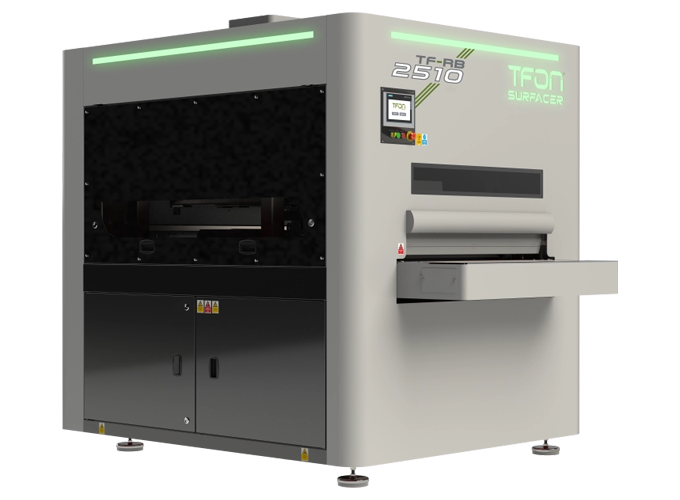
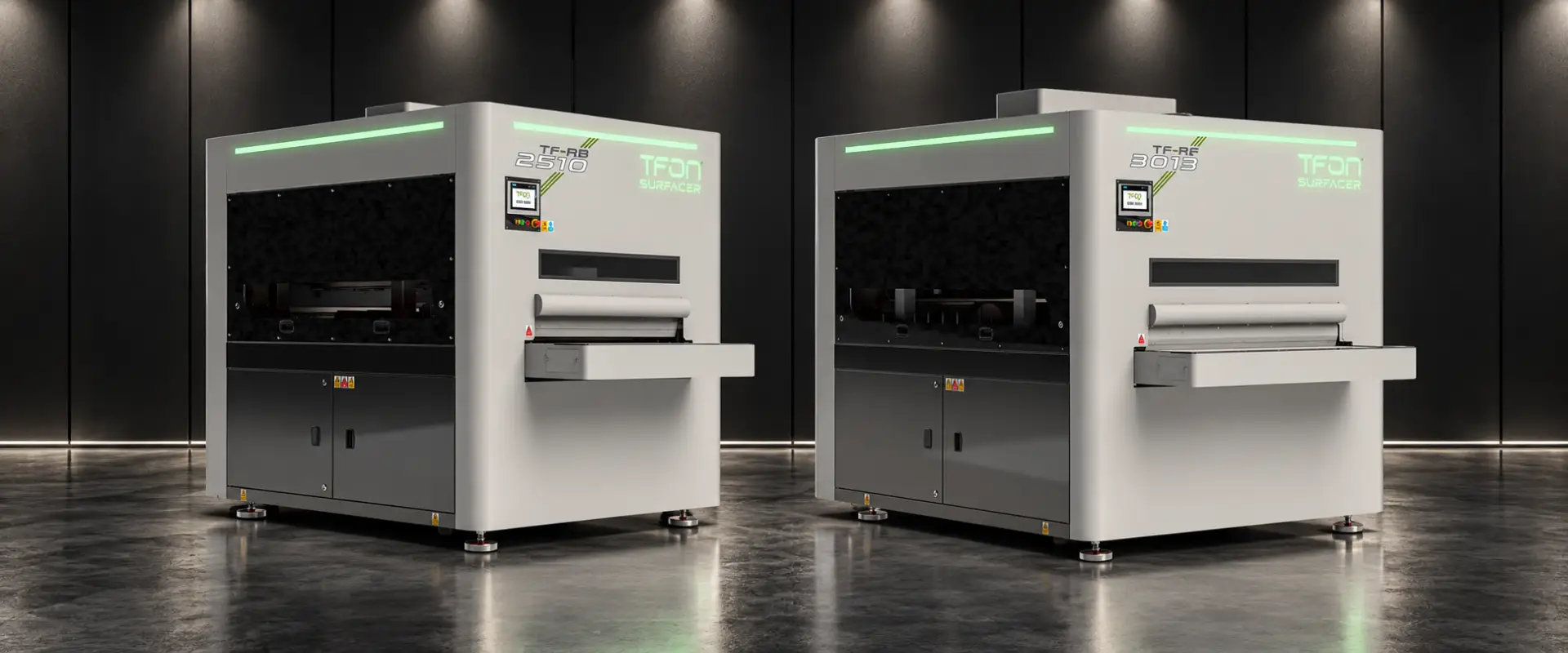
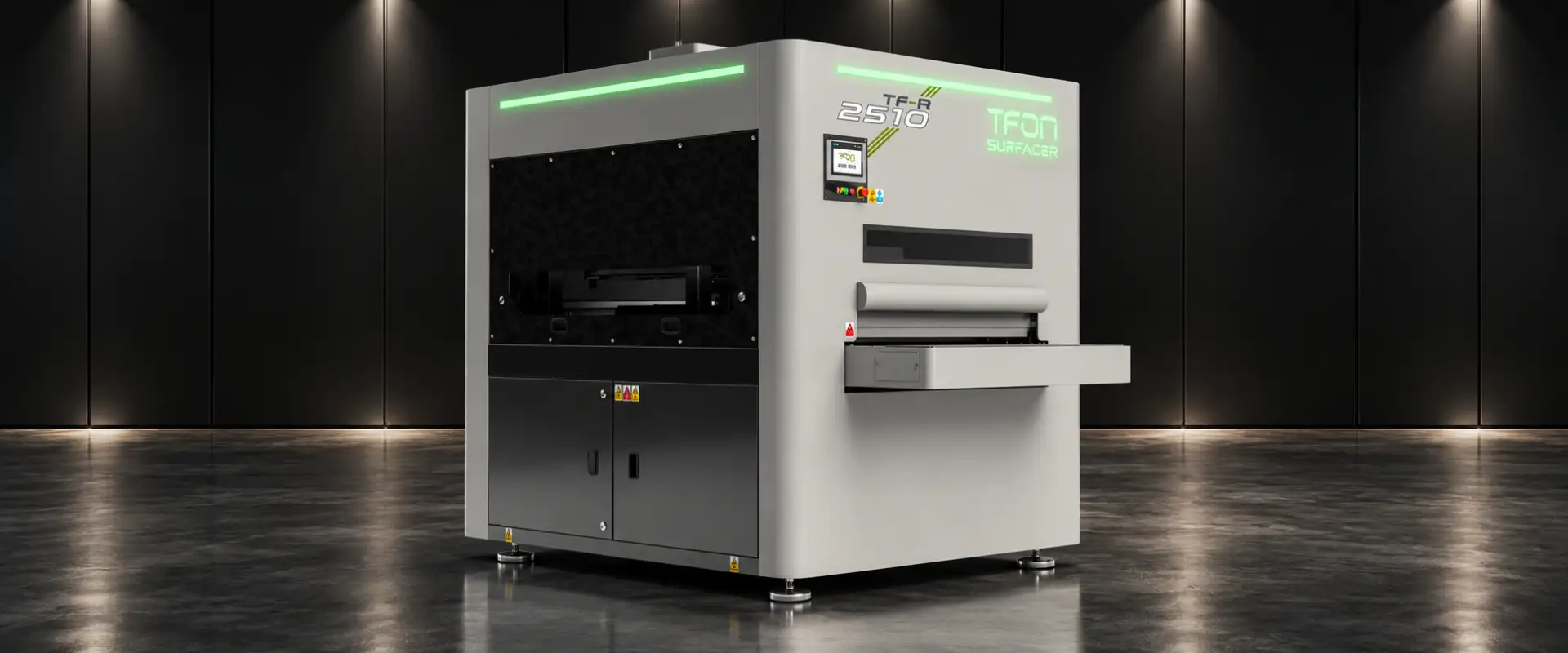
- TFON Surfacer® TF-RBC-2510 1,000 mm working width, parts up to 500 kg; heavy slag removal, belt deburring and edge rounding on one face in a single pass Specifications Request a Quote
- TFON Surfacer® TF-RBC-3013 1,300 mm working width, parts up to 600 kg; heavy slag removal, belt deburring and edge rounding on one face in a single pass Specifications Request a Quote
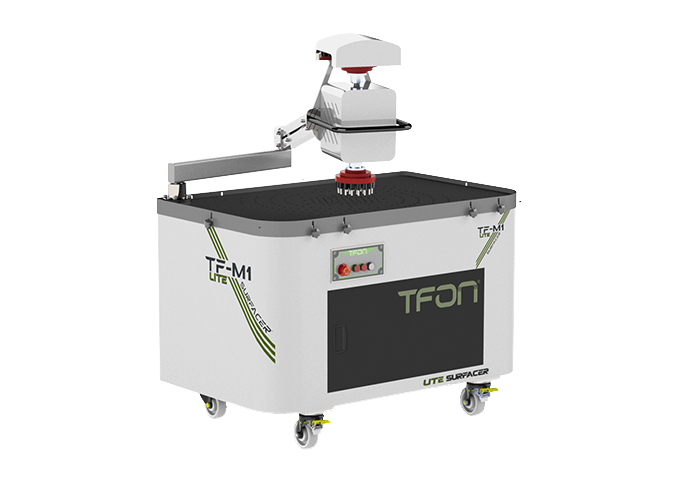
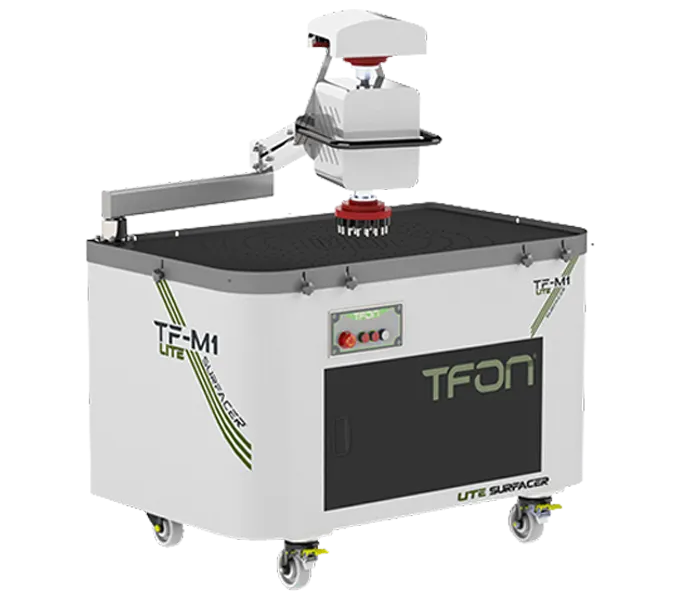
- TFON Lite Surfacer® TF-M1 LITE H2 Manual two-head machine for 3 to 200 mm parts on an 800 x 1300 mm vacuum table; takes the Heavy Slag Removal Disc Specifications Request a Quote
What Is the Difference Between Slag and Dross?
The answer depends on who is talking. A steelmaker, a welder and a plasma operator all use the word slag, and each means a different material. Dross has a precise meaning in the foundry and a loose one on the cutting table.
In metallurgy, slag is the nonmetallic byproduct of smelting and refining. Fluxes such as lime combine with silica, alumina and other impurities to form a molten layer that separates from the metal. It is tapped off and later used as aggregate or as a cement ingredient. Dross is the solid oxide skim that forms on lower-melting nonferrous melts, such as aluminum or the zinc bath of a galvanizing kettle. Because dross holds a lot of trapped metal, it is usually recycled.
In welding, slag is the crust of solidified flux left on a bead made with covered electrodes, flux-cored wire or submerged arc. It shields the cooling weld and is chipped off between passes.
In thermal cutting, both words describe one defect: molten metal and oxide that the gas jet did not blow out of the kerf and that froze to the bottom edge. Plasma documentation and most plasma operators call it dross. Oxy-fuel operators and heavy plate shops usually call it slag. Some shops keep "slag" for heavy oxy-fuel deposits and "dross" for the finer plasma or laser bead, but no standard enforces that split.
| Context | What "slag" means | What "dross" means | How it is removed |
|---|---|---|---|
| Steelmaking and smelting | Molten nonmetallic layer of fluxes and oxidized impurities that separates from iron or steel | Solid oxide skim on aluminum, zinc and other nonferrous melts; carries a lot of trapped metal | Tapped or skimmed from the furnace, ladle or kettle |
| Arc welding | Glassy crust of solidified flux on stick, flux-cored and submerged arc welds | Not a standard welding term | Chipping hammer, wire brush or needle scaler between passes |
| Plasma, oxy-fuel and laser cutting | Resolidified metal and oxide on the bottom edge; the usual oxy-fuel term | The same residue; the usual plasma and laser term | Scraper, grinder, or a heavy slag removal station on a deburring machine |
For a purchase order, an inspection record or a machine trial, describe the residue rather than relying on the word: where it sits, how large it is, how firmly it is attached and which cutting method produced it.
How Slag and Dross Form
In the furnace
Iron ore, coke and fluxes go into a blast furnace; iron and slag come out as two liquids. The slag is lighter, floats on the iron and is tapped separately. Steelmaking adds a second slag in the converter or electric arc furnace to pick up oxidized impurities. On aluminum and zinc melts, air oxidizes the surface and the oxide film gathers metal into a crumbly dross that operators skim off.
In the kerf
A plasma arc or an oxygen jet melts and oxidizes a narrow channel through the plate. The gas stream has to push that molten material out through the bottom of the cut. When speed, torch height, gas flow or power are out of balance, part of the melt loses momentum, cools at the bottom edge and fuses to the plate. What stays behind is a mix of oxides and resolidified base metal.
The plate itself shifts the result. Material grade and chemistry, surface condition (rust, mill scale, primer), flatness and plate temperature all move the window in which a cut comes off clean. A nest that cuts clean at the start of a sheet can pick up dross toward the end as the plate heats up.
Under the flux
In flux-shielded welding, the flux melts with the arc, floats to the top of the weld pool and solidifies into a glassy layer. That layer protects the hot metal from air and shapes the bead. Solid-wire MIG and TIG welding use shielding gas instead of flux, so they leave no flux slag, although MIG welds can show small glassy silicon deposits on the bead surface.
Only the kerf residue concerns a cut-part finishing line. Furnace slag never reaches the shop floor, and weld slag is removed at the welding station.
Dross on Plasma Cut Parts: Low-Speed, High-Speed and Top Spatter
Dross is the cut quality problem plasma operators deal with most often, and it comes in three recognizable forms. Identifying the form tells you whether to adjust the cutting table, the finishing step or both.
| Type | What it looks like | How hard it is to remove | Usual cause | Check first |
|---|---|---|---|---|
| Low-speed dross | Thick, bubbly or globular buildup along the bottom edge | Low adhesion; often breaks off in large pieces | Cut speed too slow for the current and thickness, so the arc widens the kerf | Cut speed against the cut chart, torch height, amperage |
| High-speed dross | Small, hard, rolled-over bead of uncut metal on the bottom edge | Tightly bonded; usually needs grinding | Cut speed too fast, so the arc lags behind the torch | Nozzle wear, cut speed, torch height, amperage |
| Top spatter | Resolidified droplets on the top surface next to the kerf | Usually easy to remove | Worn nozzle, excessive speed or high standoff | Consumables and torch height control |
Low-speed dross looks worse than it is. The deposit is large but loosely bonded, so a scraper, a chipping hammer or an impact-type removal tool usually knocks it off. High-speed dross looks minor and costs more. The small rolled bead is bonded to the edge, and removing it by hand usually means grinding every edge of every part.
Why is my plasma cutter leaving slag?
Work through the cutting side before adding finishing capacity:
- Compare the programmed speed, amperage and torch height with the cut chart for that material and thickness.
- Inspect the nozzle and electrode. A worn nozzle orifice widens the arc and moves the dross-free speed window.
- Check whether arc voltage height control is active and set correctly.
- Look at when the dross appears. Dross that grows during a shift or across a large nest often points to consumable wear or plate temperature, not to the program.
- Check gas quality and pressure, especially moisture in shop air.
Even a well-tuned table leaves some residue on certain grades and thicknesses, on bevel cuts and at corners and pierce points. Those parts still need a removal step, and it should be sized for the worst plate the table produces, not for a clean sample.
Slag on Oxy-Fuel Cut Plate
Oxy-fuel cutting is a burning process. The preheat flame brings carbon steel to ignition temperature, and a stream of pure oxygen oxidizes the iron. The reaction produces molten iron oxide that the oxygen jet blows out of the kerf. Because the process depends on that reaction, it works on carbon and low-alloy steel but not on stainless steel or aluminum. Oxy-fuel slag is almost always a carbon steel problem.
Oxy-fuel is also widely used on thick plate, so its slag deposits tend to be longer, heavier and more irregular than plasma dross. The usual causes are well known to any burner operator:
- Travel speed too slow: a wide kerf and slag that clings in large globules.
- Too much preheat: a rounded top edge and a clear increase in slag. In bad cases the part will not drop out of the skeleton.
- Too much cutting oxygen: excess slag at the bottom of the cut that is hard to remove.
- Tip too high or dirty: excessive top edge rounding and an unstable cut that leaves slag behind.
A correctly adjusted cut has a sharp top edge and a bottom edge that is free of slag or carries only a light deposit that snaps off. On thick plate, however, some slag is normal production reality, and on multi-torch tables each torch can behave differently. The finishing step has to cope with that variation.
Oxy-fuel parts often go straight into structural welding. Heavy slag interferes with fit-up and with the root of the joint, so removal is not a cosmetic step. It also decides whether the part can be leveled, drilled or beveled without damaging tooling. The application page for plasma and oxy-fuel cut parts covers the full route after cutting.
Slag in Welding
Welding slag is a deliberate product. Stick welding (SMAW), flux-cored arc welding (FCAW) and submerged arc welding (SAW) all rely on flux that melts, protects the weld pool from the atmosphere and then solidifies on top of the bead. The welder removes it with a chipping hammer, a wire brush or a needle scaler before the next pass.
Slag becomes a defect when it is trapped. Slag left between passes, or pushed ahead of the arc into a narrow groove, ends up as a slag inclusion inside the weld. Inspectors find it with radiography or ultrasonic testing, and it usually has to be ground out and rewelded. Groove geometry plays a part here: a groove that is too narrow for the process makes slag removal between passes difficult. The guide to weld bevel and groove types explains the angles, root faces and gaps involved.
Cut-edge slag and weld slag meet at the fit-up. If an oxy-fuel or plasma cut edge goes to the welder with dross still attached, the root gap varies along the joint, the root face is not where the drawing puts it, and oxide from the deposit can end up in the weld. ISO 9692-1, the reference standard for joint preparation of steels, notes that the edges of the root face should be deburred. The same logic applies to cutting residue.
For that reason, removing cut slag belongs to the cut-part route, before beveling for weld preparation, while weld slag stays at the welding station. A through-feed deburring machine is built for flat cut parts. It is not the tool for chipping flux off a welded assembly.
Slag vs Burr: Why the Difference Changes the Removal Method
Slag, dross and burrs all sit on the edge of a cut part, and shop floors often use the words loosely. For choosing a process, the difference is practical: a burr is deformed parent metal, while slag or dross is material that melted and refroze onto the edge.
| Property | Burr | Slag or dross |
|---|---|---|
| What it is | Parent metal pushed or torn past the intended edge | Molten metal and oxide that froze onto the edge |
| Typical source | Punching, shearing, sawing, machining, some laser cuts | Plasma, oxy-fuel and laser cutting |
| Attachment | Continuous with the base metal | Fused or stuck to the edge, often unevenly |
| Hardness | Close to the base metal, sometimes work hardened | Varies; oxide-rich deposits can be hard and abrasive |
| First removal step | Abrasive belt, file or brush | Breaking or knocking the deposit off, then abrasive cleanup |
That difference sets the order of operations. An abrasive belt cuts a burr efficiently because the burr is thin, ductile and continuous. The same belt pressed against heavy slag spends most of its life knocking lumps off, loads or tears quickly and can leave slag roots in the corners. A heavy deposit comes off faster when it is broken first, by impact or by pins that strike the edge, and the belt then cleans what remains.
Many thermally cut parts carry both. A plasma cut part can have dross on the bottom edge, a small burr where the dross broke off, sharp corners and an oxide layer on the cut face. Each of those needs its own check. The guide What Is a Burr? covers burr types and measurement, and the guide on oxygen vs nitrogen laser cutting covers the oxide layer that stays on laser cut edges.
How to Remove Slag and Dross from Steel Plate
By hand: scrapers, hammers and needle scalers
Low-speed plasma dross and loose oxy-fuel slag often come off with a scraper, a chisel or a chipping hammer. A pneumatic needle scaler handles heavier deposits with less effort. Hand removal suits single parts and short runs, but results depend on the operator, and parts with many internal cut-outs take a long time.
By grinding
High-speed dross usually needs an angle grinder with a grinding wheel or flap disc. Grinding works, but it is slow, it can gouge the cut edge and change the part outline, and it exposes the operator to vibration, noise, sparks and dust for as long as the job lasts. On a production volume of thermally cut parts, grinding is usually the most expensive step between the table and the welding bay.
By machine: a heavy slag station followed by belt and brush
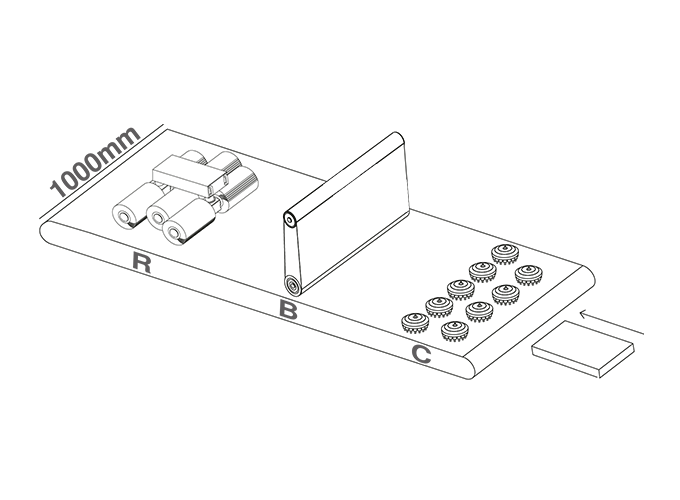
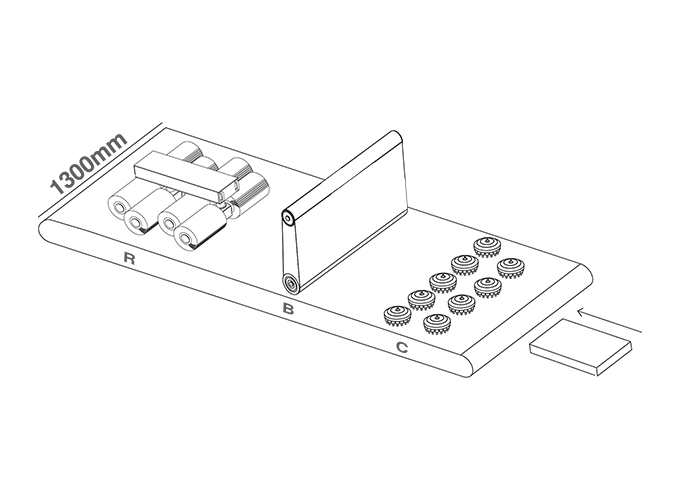
A through-feed deburring machine for thermally cut plate splits the job into stages. A heavy slag station breaks the deposit off, an abrasive belt removes the remaining roots and the burr, and brush or flap wheel stations treat the edge. TFON builds this sequence into the TF-RBC-2510 and TF-RBC-3013. In the model code, C is the heavy deburring station, B the abrasive belt and R the edge rounding station.
The heavy stage uses the TFON Heavy Slag Removal Disc: a Ø150 mm disc with rubberized pins that runs at 700 rpm and breaks slag off the edges of oxy-fuel and plasma cut parts. The TF-RBC-2510 works parts up to 1,000 mm wide and 500 kg, the TF-RBC-3013 up to 1,300 mm wide and 600 kg. Both have a published thickness capacity of up to 120 mm, subject to application review, a conveyor speed of 0.6 to 4.0 m/min and vacuum and/or magnetic part holding.
The machine works one face per pass. Feed the part with the dross side facing the stations, and plan a second pass if the other face also needs treatment. The overview of the slag removal machine and the slag removal process page explain the route in more detail, and the replacement discs are listed under discs and brushes.
For low volumes and rework, the Lite Surfacer TF-M1 LITE H2 manual machine uses the same Heavy Slag Removal Disc, with the operator guiding the part.
Slag Removal Checklist for Thermally Cut Parts
Use this sequence when you set up slag removal for a new part family or plan a trial on a machine:
- Photograph a straight edge, a corner and a pierce point on the dross side, with a scale in the picture.
- Record the cutting method, material grade, thickness and the table or torch that cut the part.
- Classify the residue: low-speed dross, high-speed dross, top spatter or oxy-fuel slag.
- Check the cut chart, consumables and torch height before accepting the residue as normal.
- Define what comes next: welding, beveling, leveling, bending, painting or powder coating. The next operation sets the acceptance level.
- Send the worst plate for the trial, not a clean sample. Include a part with small internal cut-outs.
- After removal, inspect for slag roots, a remaining burr, sharp corners and damage to the intended edge.
- Record orientation, number of passes and tooling so the result can be repeated in production.
Slag removal does not make a part ready for welding or coating on its own. It removes the deposit. Edge condition, oxide on the cut face and fit-up are separate checks, and each one needs its own acceptance line on the inspection record.
TFON Machines for This Job
-
TFON Surfacer® TF-RBC-2510
1,000 mm working width, parts up to 500 kg; heavy slag removal, belt deburring and edge rounding on one face in a single pass
Specifications Request a Quote -
TFON Surfacer® TF-RBC-3013
1,300 mm working width, parts up to 600 kg; heavy slag removal, belt deburring and edge rounding on one face in a single pass
Specifications Request a Quote -
TFON Lite Surfacer® TF-M1 LITE H2
Manual two-head machine for 3 to 200 mm parts on an 800 x 1300 mm vacuum table; takes the Heavy Slag Removal Disc
Specifications Request a Quote
Frequently Asked Questions
Does laser cutting leave dross?
Yes. Laser cutting can leave a fine bead of resolidified metal on the bottom edge, especially with nitrogen or air on stainless steel and aluminum. It is usually smaller than plasma dross and is often called a burr. Focus position, gas pressure, nozzle condition and cut speed control how much forms.
Can a standard deburring machine remove heavy slag?
It depends on how firmly the slag is attached. Light, loose dross can come off on a belt station. Heavy, tightly bonded oxy-fuel or plasma slag needs a separate heavy removal stage, such as a pin-disc station, before the belt. On TFON Surfacer machines that stage is the C station of the TF-RBC series.
Should slag be removed before welding a cut edge?
Yes. Slag on the joint edge changes the root gap along the joint, moves the root face and can bring oxide into the weld. Remove it before fit-up, then check the edge against the drawing. Slag removal alone does not qualify the joint; the welding procedure and weld inspection still apply.
Is slag removal the same as deburring?
No. Slag removal takes off resolidified metal and oxide from a thermal cut. Deburring removes parent metal pushed past the intended edge. Many thermally cut parts need both, in that order: break the slag off first, then remove the remaining burr and treat the edge.
Why does dross get worse during a long plasma nest?
The usual reasons are nozzle and electrode wear and a rising plate temperature. A worn nozzle widens the arc and shifts the speed at which the cut comes off clean, and a hot plate behaves differently from a cold one. Check consumables and compare the first and last parts of the nest before changing the program.
Let Us Review Your Part
Share the material, cutting method, part dimensions and the next operation, with photos of both faces. We will recommend the machine and station sequence that fits the part.