

Knowledge Base
How to Choose a Sheet Metal Leveler (Roller Leveling Machine)
A sheet metal leveler, or roller leveling machine, is the machine that flattens sheet, plate and cut parts by passing them between two staggered banks of rolls. The rolls bend the part up and down with decreasing force until it leaves flat, with its residual stresses more evenly distributed.
TFON Machines for This Job
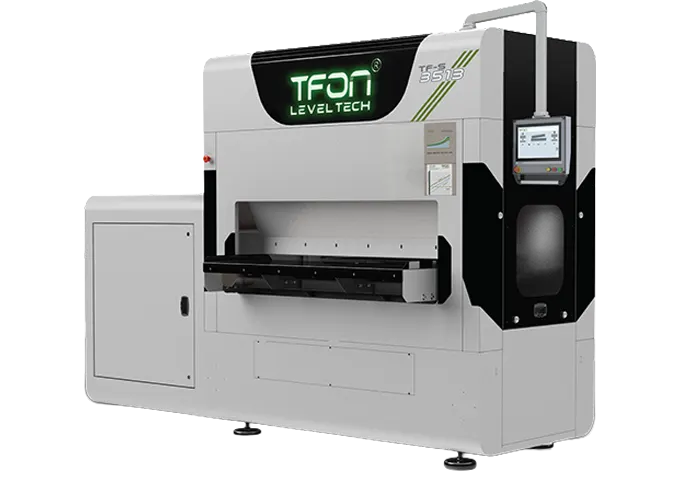
- TFON Leveltech® TF-S 3513 Thin sheet leveler; 0.3-5 mm material thickness; 1,300 mm maximum width; 35 mm minimum part length Specifications Request a Quote
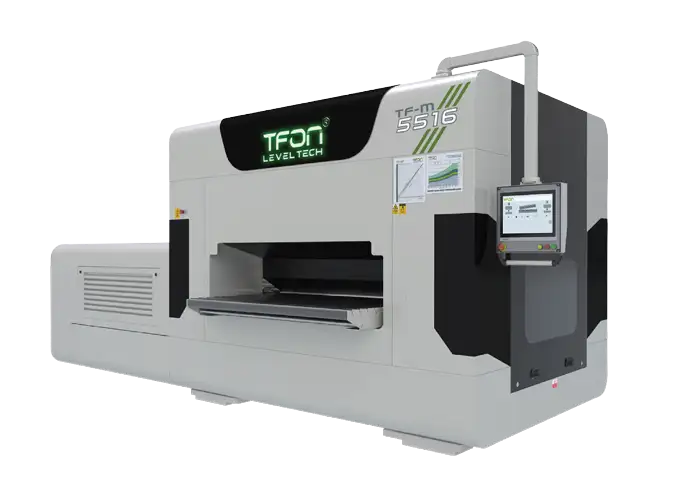
- TFON Leveltech® TF-M 5516 Leveling machine; 0.5-15 mm material thickness; 1,600 mm maximum width; servo hydraulic / PC gap control Specifications Request a Quote
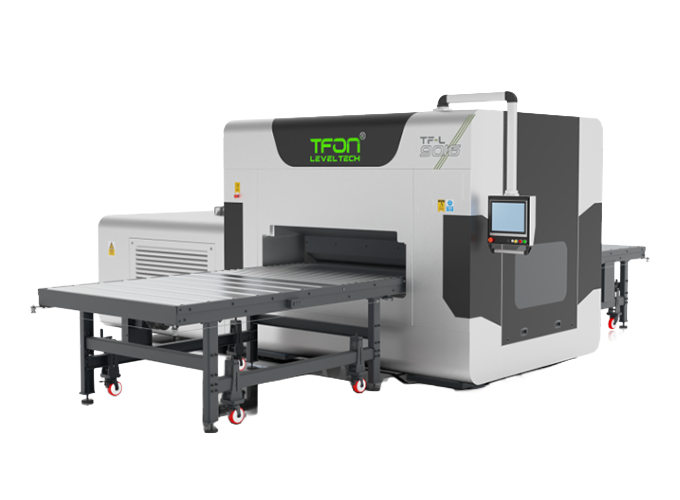
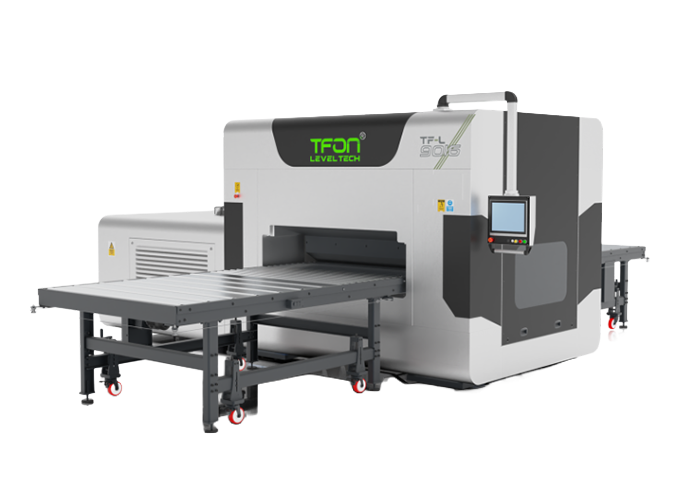
- TFON Leveltech® TF-L 9020 Sheet metal leveler; 1-30 mm material thickness; 2,000 mm maximum width; 160 mm minimum part length Specifications Request a Quote
What Is the Machine That Flattens Metal Called?
The machine that flattens sheet metal and plate is a roller leveler, also called a leveling machine, a sheet metal leveler or a precision leveler. A roller leveler built for individual cut parts rather than coil is often called a parts leveler. Coil processing lines use coil levelers and straighteners inline, ahead of a press or cut-to-length shear.
Two other machines get confused with levelers. A rolling mill flattens metal in a different sense: it reduces thickness by squeezing the material between rolls. A plate rolling machine does the opposite of leveling, bending flat plate into cylinders and cones. Neither is used to correct distortion in parts.
Levelers exist because flat stock does not stay flat. Sheet and plate carry residual stresses from rolling and coiling. Laser, plasma and punching operations release those stresses unevenly and add heat or deformation at the edges. The result is bowing, twisting, edge wave or oil canning in parts that looked flat as a sheet. A leveler corrects that shape and, by working the whole part, leaves the stresses more evenly distributed so the part stays flat through bending, welding and assembly.
What flat means in practice
Flatness is a form tolerance: the distance between two parallel planes that contain the whole surface. It is measured with the part in a defined condition. As TFON's leveling guidance notes, a part that sits flat in a fixture may spring away when it is released. Before you buy a leveler, decide how you will measure flatness, on which parts and in which condition, so that trials and acceptance use the same method. The sheet metal leveling process page covers inspection in more detail.
How Does a Roller Leveler Work?
A roller leveler has two banks of work rolls, one above and one below the part. The upper rolls sit in the gaps between the lower rolls, so the part follows a wave path as it passes through. The key setting is roll penetration: how far the upper bank pushes down into the lower bank.
What happens along the machine:
- Entry: penetration is deep. The part is bent past its yield point, first one way and then the other. Both surfaces yield in tension and compression, and the original curvature and stress pattern are overwritten.
- Middle: penetration decreases roll by roll. Each bend is smaller than the last, so the plastic zone shrinks toward the surfaces.
- Exit: the last rolls bend the part within its elastic range. It leaves straight, without a new permanent curve.
The bending pattern resembles a decaying wave. Because the part is worked plastically across its thickness, uneven stresses are evened out, which is why leveled parts tend to stay flat when they are cut or formed later.
Work rolls and backup rolls
Thin work rolls bend thin material effectively, but they deflect under load. Backup rolls, arranged in rows behind the work rolls, support them along their length. On many levelers the backup rolls can be adjusted section by section across the width. That lets the operator apply more bending at the center or at the edges, which is how a leveler corrects center buckle and edge wave, not just a simple bow.
Gap control and settings
Penetration and the entry and exit gaps are set by servo drives, either electromechanical or hydraulic. Machines with PC control store settings per part as a recipe, so a job can be rerun with the same result. Thick or strong material may need several passes; thin parts are often leveled in one or two.
Roller Leveling vs Flame Straightening and Press Straightening
Shops flatten metal in three main ways. Each has a place.
Flame straightening heats small, chosen areas with a torch. The heated spot tries to expand, is restrained by the cold metal around it and yields; as it cools it shrinks and pulls the part toward flat. It works on large weldments, beams and structures that cannot go through a machine. It depends heavily on operator skill, is slow on batches, and too much heat changes the steel. AWS D1.1 caps the temperature of heated areas at 1100°F (600°C) for quenched and tempered steel and 1200°F (650°C) for other steels.
Press straightening uses a hydraulic press with supports and a ram to bend the part back, point by point. It suits thick plate, bars and weldments. It is operator-dependent and treats local areas one at a time, and the press can leave marks.
Roller leveling treats the whole part in one pass through the rolls. It is fast and repeatable for batches of flat parts, but it only accepts flat parts within the machine's thickness, width and length range.
| Method | How it works | Parts it suits | Repeatability | Batch speed | Main limits |
|---|---|---|---|---|---|
| Roller leveling | Alternating plastic bending with decreasing amplitude | Sheet, plate, laser, plasma and punched parts | High with stored settings | High | Thickness, width and minimum part length of the machine |
| Press straightening | Local bending with a ram and supports | Thick plate, bars, weldments | Depends on the operator | Low | Local correction only; possible marks |
| Flame straightening | Local heating and restrained shrinkage | Large weldments and structures | Depends on the operator | Low | Temperature limits; skill; can affect material properties |
| Hand hammering and manual methods | Local stretching by impact | Single parts, repairs | Low | Very low | Marks, noise, inconsistent results |
Stretch and tension leveling, which pull coil past its yield point, belong to mills and service centers rather than fabrication shops.
Advantages of Roller Leveling
For fabricators who cut flat parts in volume, roller leveling brings practical gains that show up in the departments downstream:
- Whole-part treatment. Every part passes through the same bending sequence across its full width and length, not just at the spots an operator chose to fix.
- Repeatability. With stored settings, the same part number gets the same treatment every time, across shifts and operators.
- Speed on batches. A batch of cut parts can be fed continuously, instead of being straightened one by one on a press table.
- No heat. Leveling is a cold process. There is no heat tint, no scale and no risk of overheating quenched and tempered steels.
- Stable parts downstream. Evened-out stresses mean less springback surprise in bending and less movement during welding and machining.
- Better fit-up. Flat parts sit in fixtures without force, which gives consistent weld gaps and less rework.
- Easier automation. Robots, press brake gauges and welding fixtures assume a flat part. Leveled parts meet that assumption.
There are limits too, and a buying decision should weigh them honestly. A leveler does not treat three-dimensional weldments. Perforated parts and parts with large openings respond differently from solid blanks of the same thickness. And leveling is not a stress-relief heat treatment: it improves flatness and evens out stresses, but it does not replace a thermal treatment where a code requires one. Our guide to stress relief after welding explains where each method fits.
Roller Leveler vs Parts Leveler vs Straightener
The three names describe machines with the same basic principle, built for different jobs.
A straightener usually has fewer, larger rolls and sits in a coil line ahead of a press or feeder. Its job is to take coil set and crossbow out of strip. It bends the material less aggressively and does not correct shape defects such as edge wave or center buckle.
A roller leveler, or precision leveler, has more rolls of smaller diameter at closer pitch, supported by backup rolls. It bends the material past yield across its thickness and can correct shape defects as well as curvature. Precision levelers are used both in coil lines and as standalone machines.
A parts leveler is a roller leveler designed for discrete parts: laser-cut, plasma-cut and punched blanks of different shapes and sizes. It needs to handle short parts, parts with holes and cutouts, and parts that arrive in random orientation. Minimum part length, roll cleaning and part support at entry and exit matter more than on a coil machine.
| Feature | Straightener | Roller (precision) leveler | Parts leveler |
|---|---|---|---|
| Material fed | Coil strip | Coil strip or sheets | Individual cut parts and sheets |
| Rolls | Fewer, larger | More, smaller, with backup rolls | More, smaller, with backup rolls |
| Corrects | Coil set, crossbow | Curvature and shape defects, stress pattern | Curvature and shape defects in cut parts, stress pattern |
| Typical position | Inline ahead of a press or feeder | Inline or standalone | Standalone after cutting |
| Key buying factor | Coil width and thickness | Flatness tolerance, material range | Minimum part length, part variety, holes |
For a fabrication shop with laser or plasma cutting, the machine to evaluate is a parts leveler. TFON Leveltech machines are built for this work, on laser-cut and punched parts and on plasma and oxy-fuel cut parts.
Buying Factors: Thickness, Width and Part Length
Thickness range and material strength
Start with the thinnest and thickest parts you need to level, then add the material. Thickness alone does not decide the machine: a leveler that handles mild steel at a given thickness may struggle with high-strength steel or abrasion-resistant plate at the same thickness, because the force needed rises with yield strength. Stainless steel work-hardens; aluminum marks easily. List the grades, not just the gauges.
Treat published thickness ranges the way TFON describes its own: they are selection inputs, not a flatness guarantee for every material. A narrow solid strip and a wide part with large openings can respond differently even at the same nominal thickness.
Working width
Maximum part width sets the machine width. Parts that are wide relative to their length, and parts fed at an angle, need margin. A wider machine is heavier and needs more floor space, so size it to your real part mix instead of the largest sheet you might ever buy.
Minimum part length
A part must span enough rolls to be gripped and bent through the full sequence. Short parts, small brackets for example, fall between rolls on a machine built for plate. Check the minimum part length against your smallest part, and ask whether small parts can be leveled on a carrier sheet. On TFON Leveltech machines the minimum material length is 35 mm on the XS and TF-S series, 110 mm on TF-M and 160 mm on TF-L.
Part type and condition
- Share of perforated parts and parts with large cutouts.
- Incoming distortion: gentle bow, sharp kinks or heat-distorted plasma parts.
- Surface requirements: pre-finished, coated or film-protected sheets need clean rolls and gentle settings.
- Remaining dross or burr, which can mark rolls and parts; deburr or remove slag first where needed.
Buying Factors: Rolls, Control and Changeover
Roll count, diameter and pitch
Roll geometry follows material thickness. Thin sheet needs small-diameter rolls at close pitch so that it can be bent past yield at all. Thick plate needs larger rolls and wider pitch to carry the forces. That is why one machine rarely covers everything from foil-thin sheet to heavy plate, and why levelers come in series by thickness range. More rolls give more bending cycles and finer correction. Ask each supplier for roll count, work roll diameter, roll pitch and backup roll layout for the thickness range you quoted.
Control type
Two approaches are common. Servo-mechanical gap adjustment suits thinner material and lower forces. Servo-hydraulic adjustment with PC control suits thicker, stronger material and higher forces. In both cases look for:
- Recipe storage by part number, so settings are repeatable.
- Clear display of penetration, entry and exit gap.
- Protection against overload when a part is thicker or stronger than set.
- A touch screen interface operators can learn quickly.
Roll changeover and cleaning
Scale, zinc and dirt build up on rolls and transfer to parts. A quick roll change or roll cassette system shortens cleaning and maintenance downtime and lets you swap roll sets for different jobs. On TFON Leveltech machines, quick changeover for the leveling rolls is available as an option.
Installation and floor
Levelers for plate are heavy machines. Check weight, footprint and height against your floor, foundation and crane capacity. Plan infeed and outfeed conveyors or tables, and space for parts to be stacked by operators or robots. TFON's installation, operator training and maintenance services support the machine after delivery.
TFON Leveltech Series Compared
TFON Leveltech machines are roller levelers for sheet, plate and cut parts, built in four series by thickness range. All models have touch screen control, and quick changeover for the leveling rolls is optional across the range. The table lists published data for each series.
| Series | Models and maximum material width | Material thickness | Minimum material length | Leveling gap adjustment | Total weight |
|---|---|---|---|---|---|
| XS | XS-3520: 200 mm | 0.3-5 mm | 35 mm | Servo mechanic | 1,700 kg |
| TF-S | TF-S 3560: 600 mm; TF-S 3511: 1,100 mm; TF-S 3513: 1,300 mm; TF-S 3516: 1,600 mm | 0.3-5 mm | 35 mm | Servo mechanic | 3,200-6,000 kg |
| TF-M | TF-M 5560: 600 mm; TF-M 5511: 1,100 mm; TF-M 5513: 1,300 mm; TF-M 5516: 1,600 mm; TF-M 5520: 2,000 mm | 0.5-15 mm | 110 mm | Servo hydraulic / PC control | 12,900-22,400 kg |
| TF-L | TF-L 9060: 600 mm; TF-L 9011: 1,100 mm; TF-L 9013: 1,300 mm; TF-L 9016: 1,600 mm; TF-L 9020: 2,000 mm | 1-30 mm | 160 mm | Servo hydraulic / PC control | 28,500-39,600 kg |
How to read the series: the XS and TF-S machines are thin sheet levelers for punched and laser-cut parts up to 5 mm. TF-M covers the common range of laser-cut and plasma-cut plate up to 15 mm. TF-L handles plate up to 30 mm. Within a series, the models differ in width, height and weight. As with any leveler, thickness limits depend on material strength and part geometry, and achievable flatness should be confirmed on your parts. The Leveltech leveling machines page and the machine comparison table list full specifications for each model.
What to Send With a Leveler Quote Request
A leveler quote is only as good as the information behind it. Send the following, and ask each supplier to answer against the same list:
- Materials and grades, with yield strength where known: mild steel, high-strength steel, stainless steel, aluminum.
- Thickness range, thinnest and thickest, and the share of parts at each end.
- Part sizes: maximum width and length, and the smallest part you need to level.
- Part types: sheets or cut parts, share of perforated parts, typical cutouts.
- Cutting method: laser with oxygen or nitrogen, plasma, oxy-fuel or punching.
- Flatness tolerance and how you measure it: instrument, support condition, span.
- Incoming distortion: photos and rough values for typical bad parts.
- Volume: parts per shift and batch sizes.
- Next operations: bending, welding, machining, coating.
- Trial parts: real parts in the as-cut condition for a leveling test, if the supplier offers one.
Record the result of any trial with the same flatness method you will use in production: part support, measured area, instrument and the limits on the drawing. Welding, machining and forming can change a leveled part, so check flatness again at the downstream operation if distortion appears later.
Send your part list through the contact form and TFON will recommend a Leveltech series and width for it.
TFON Machines for This Job
-
TFON Leveltech® TF-S 3513
Thin sheet leveler; 0.3-5 mm material thickness; 1,300 mm maximum width; 35 mm minimum part length
Specifications Request a Quote -
TFON Leveltech® TF-M 5516
Leveling machine; 0.5-15 mm material thickness; 1,600 mm maximum width; servo hydraulic / PC gap control
Specifications Request a Quote -
TFON Leveltech® TF-L 9020
Sheet metal leveler; 1-30 mm material thickness; 2,000 mm maximum width; 160 mm minimum part length
Specifications Request a Quote
Frequently Asked Questions
What is the difference between a roller leveler and a straightener?
A straightener has fewer, larger rolls and removes coil set and crossbow from strip in a coil line. A roller leveler has more, smaller rolls supported by backup rolls. It bends the material past yield across its thickness and corrects shape defects such as edge wave and center buckle as well as curvature.
How many rolls does a sheet metal leveler need?
It depends on the thickness range and the flatness tolerance. Thin sheet needs more rolls of small diameter at close pitch; thick plate needs larger rolls at wider pitch. More rolls give more bending cycles and finer correction. Ask each supplier for roll count, roll diameter and pitch for the exact thickness range you quote.
Can a leveler flatten laser cut parts with holes?
Usually, yes. Parts levelers are built for laser-cut and punched parts with holes and cutouts. Perforated parts respond differently from solid blanks of the same thickness, because the openings change how the part bends. Level sample parts in a trial and measure flatness before settling on the machine and settings.
Does a leveler remove residual stress completely?
No. Roller leveling evens out and reduces residual stresses by bending the part past yield, which makes it flatter and more stable in later operations. It does not make the material stress-free, and a flatness result does not measure the stress state. It also does not replace a stress-relief heat treatment where a code requires one.
What thickness can a roller leveler handle?
Each machine has its own range, set by roll size and force. TFON Leveltech machines cover 0.3-5 mm on the XS and TF-S series, 0.5-15 mm on TF-M and 1-30 mm on TF-L. These ranges are selection inputs; the achievable result also depends on material strength and part geometry.
Let Us Review Your Part
Share the material, cutting method, part dimensions and the next operation, with photos of both faces. We will recommend the machine and station sequence that fits the part.